


Our News
Find out about our latest news here.
Latest News
- ▶ Buying Pressure Vessels from China: How to Read a Q345R and an SA-516 Gr.70 Mill Certificate
- ▶ Boyu Heavy Industry Adds Power Engineering Construction License to Its ASME-Certified Manufacturing Base
- ▶ Inside the Shop: What Those Chalk Marks on a Vessel Mean
- ▶ Gas Turbine HRSG Heating Surfaces: Design, Materials, Finned Tubes and Manufacturing
- ▶ Waste Heat Boilers Explained: Complete Units vs. Heating Surface Modules
- ▶ Sourcing Large Pressure Vessels from China: What Buyers Should Verify Before Awarding
Message
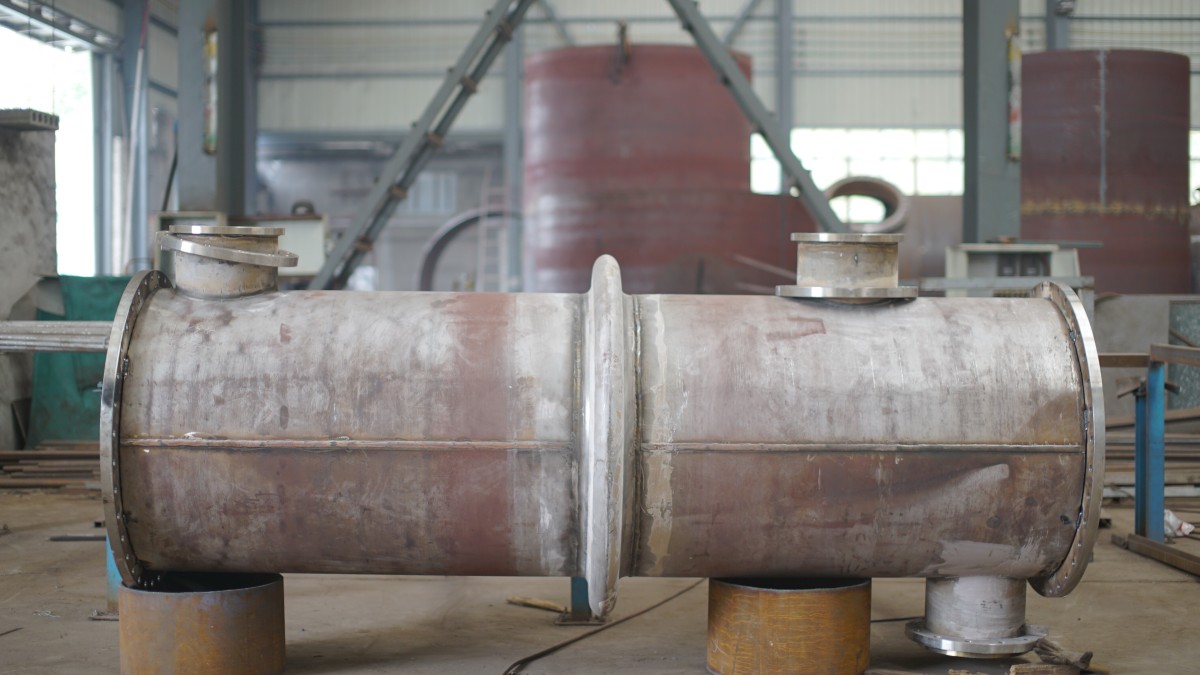
Structure, Working Principle, Applications, and Selection Guidelines
1. What Is an Expansion Joint Shell-and-Tube Heat Exchanger?
An Expansion Joint Shell-and-Tube Heat Exchanger is a modified form of the conventional shell-and-tube heat exchanger, in which a metal expansion joint (bellows) is installed on the shell side to compensate for axial thermal expansion differences between the shell and the tube bundle.
In traditional fixed tubesheet heat exchangers, the shell and tubes are rigidly constrained. When significant temperature differences exist between the shell-side and tube-side media, thermal expansion mismatch can generate high thermal stress. The expansion joint allows controlled axial movement of the shell, effectively reducing thermal stress and improving long-term reliability under demanding operating conditions.
In simple terms:
When the shell and the tube bundle want to expand by different amounts, the expansion joint absorbs the difference.
2. Why Does a Shell-and-Tube Heat Exchanger Need Thermal Compensation?
During operation, shell-and-tube heat exchangers are typically subjected to two main sources of thermal stress.
2.1 Thermal Expansion Caused by Temperature Difference
High shell-side temperature and relatively low tube-side temperature (or vice versa)
Different thermal expansion rates between the shell and tube bundle
In rigid structures such as fixed tubesheet designs, thermal stress tends to concentrate at:
The shell-to-tubesheet weld
Tube-to-tubesheet joints (expanded or welded)
The transition area between shell courses and heads
2.2 Thermal Fatigue Caused by Temperature Cycling
Frequent start-up and shutdown
Large fluctuations in operating temperature
Repeated thermal loading leading to fatigue cracking over time
The harsher and more frequent the thermal cycles, the more critical thermal compensation becomes.
3. Main Components of an Expansion Joint Shell-and-Tube Heat Exchanger
A typical expansion joint shell-and-tube heat exchanger consists of the following components:
Shell – Pressure boundary on the shell side
Tube Bundle – Heat transfer tubes, baffles, tie rods, and spacers
Tubesheet – Separates shell-side and tube-side fluids and secures tube ends
Channel / Bonnet – Distributes tube-side flow and allows inspection
Expansion Joint – Usually a metallic bellows installed on the shell
Saddle Supports – Commonly used for horizontal installation
The expansion joint is typically located:
At the middle section of the shell near the high-temperature zone, or
Close to the fixed tubesheet end to effectively absorb axial displacement
4. How the Expansion Joint Works (Key Mechanism)
From an engineering perspective, the function of the expansion joint can be summarized in three key points:
Absorption of Axial Displacement
Compensates for differential thermal expansion between the shell and tube bundle.Reduction of Stress at Critical Locations
Minimizes stress concentration at the shell-to-tubesheet connection.Improved Reliability Under Thermal Cycling
Reduces the risk of thermal fatigue cracking and leakage during repeated start-stop operation.
5. Typical Operating Conditions and Applications
An expansion joint shell-and-tube heat exchanger is particularly suitable for the following conditions.
5.1 Large Temperature Difference
Significant temperature difference between shell side and tube side
Frequent temperature fluctuations and thermal cycling
5.2 Moderate Pressure with Severe Thermal Conditions
Shell-side pressure is generally low to medium
Thermal stress and fatigue life are primary design concerns
5.3 When Floating Head or U-Tube Designs Are Not Preferred
Floating head heat exchangers allow thermal expansion but involve higher cost, larger size, and more complex structure
U-tube heat exchangers allow expansion but have limitations in cleaning and stress distribution
Expansion joint designs provide a cost-effective compromise between thermal flexibility and structural simplicity
6. Advantages and Limitations
Advantages
Relatively simple structure compared to floating head designs
Cost-effective solution for thermal expansion compensation
Clear compensation mechanism for axial thermal movement
Well suited for thermal cycling service, reducing fatigue-related failures
Limitations and Considerations
The expansion joint is a relatively vulnerable component subject to fatigue, corrosion, and erosion
Not recommended for highly corrosive or severely erosive shell-side media unless special materials or liners are used
Sensitive to installation quality and external piping loads
Expansion joint life must be evaluated based on displacement, pressure, temperature, and cycle count
A common engineering principle applies:
An expansion joint can compensate for thermal expansion, but it cannot replace proper piping stress control.
7. Key Design and Manufacturing Considerations
When designing and manufacturing an expansion joint shell-and-tube heat exchanger, the following aspects are critical:
Thermal displacement calculation based on temperature difference, equipment length, and material expansion coefficients
Expansion joint type selection (single-ply, multi-ply, with liner, with limit rods)
Pressure thrust and stability analysis, including effects on shell and supports
Fatigue life assessment, especially for frequent start-up and shutdown conditions
Material compatibility with operating temperature, corrosion potential, chlorides, and sulfur compounds
Welding quality and NDE requirements, such as RT, UT, and PT according to applicable codes
Installation and piping stress control, including guides, anchors, and flexible connections where necessary
8. Selection Comparison: Expansion Joint vs. Floating Head vs. U-Tube
Large temperature difference + frequent bundle removal required → Floating Head
Large temperature difference + U-bending acceptable + manageable cleaning requirements → U-Tube
Moderate pressure + large temperature difference + compact structure + cost efficiency required → Expansion Joint Shell-and-Tube Heat Exchanger
9. Conclusion
The expansion joint shell-and-tube heat exchanger is a widely applied thermal compensation solution in industrial heat transfer systems. By incorporating a metallic expansion joint into the shell, it effectively absorbs axial thermal expansion caused by temperature differences, significantly reducing thermal stress and fatigue risk.
When properly designed with suitable materials, fatigue evaluation, and controlled external piping loads, this type of heat exchanger achieves an excellent balance between reliability, cost, and manufacturing efficiency, making it a preferred option for many applications involving thermal cycling and large temperature gradients.
PROFESSIONAL CONSULTATION
If you are interested in our products and want to know more details, please leave a message here, we will reply you as soon as we can.