


Our News
Find out about our latest news here.
Latest News
- ▶ Spiral Plate vs Shell and Tube Heat Exchanger: Which One Fits Your Duty?
- ▶ CDQ Waste Heat Boilers: What Governs the Design, and What Actually Breaks
- ▶ What Are the Heating Surfaces in a Waste Heat Boiler? Superheater, Evaporator and Economizer Explained
- ▶ Buying Pressure Vessels from China: How to Read a Q345R and an SA-516 Gr.70 Mill Certificate
- ▶ Boyu Heavy Industry Adds Power Engineering Construction License to Its ASME-Certified Manufacturing Base
- ▶ Inside the Shop: What Those Chalk Marks on a Vessel Mean
Message
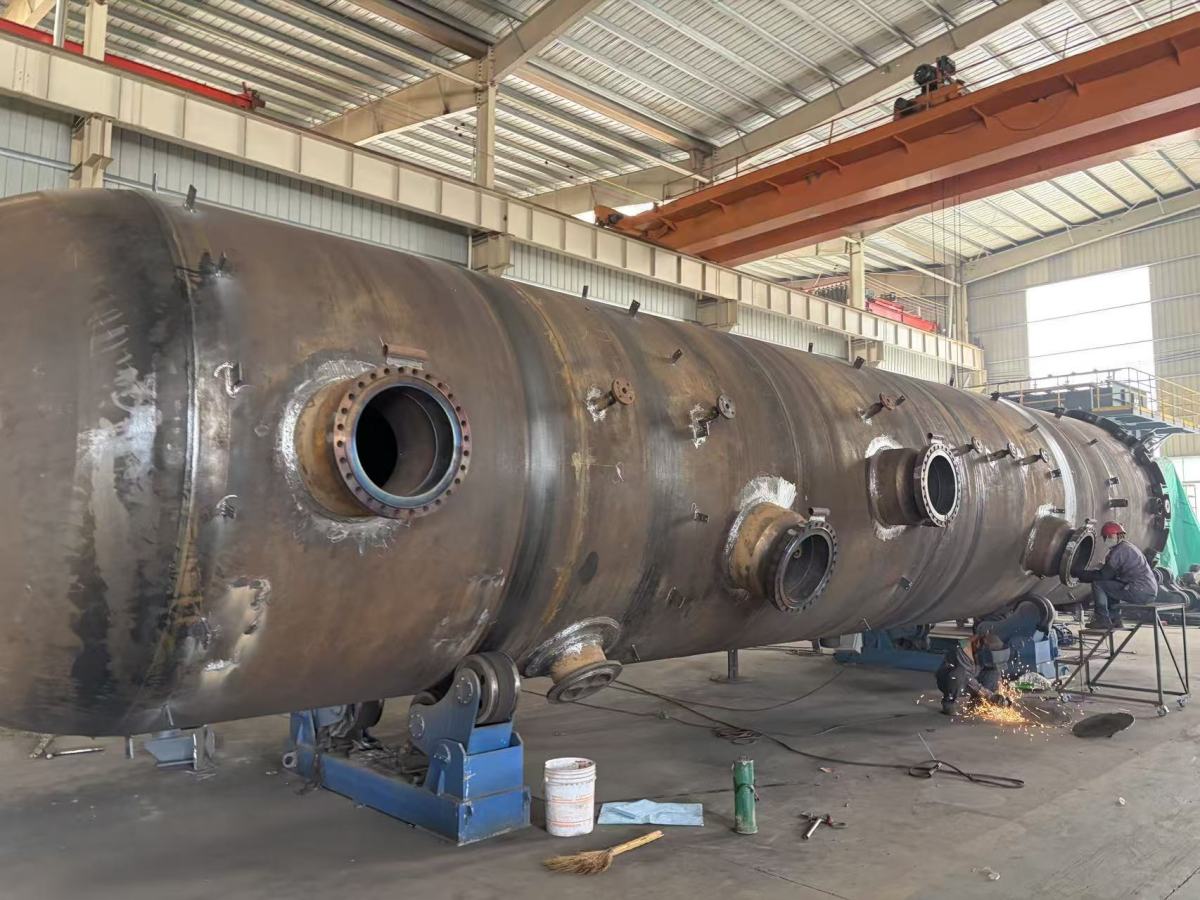
1. What Is a Gas Treatment Tower?
A gas treatment tower is a key piece of equipment used in the chemical, energy, and environmental protection industries for gas purification, absorption, separation, and reaction processes. Its primary function is to remove harmful components from gas streams or recover valuable substances through gas–liquid or gas–solid contact.
Gas treatment towers are widely applied in:
- Coking industry gas cleaning systems
- Petrochemical acid gas treatment (H₂S, CO₂ removal)
- Industrial waste gas treatment and air pollution control
- Power generation and flue gas desulfurization systems
2. Main Types of Gas Treatment Towers
2.1 Packed Towers
Packed towers utilize internal packing materials to increase the contact area between gas and liquid phases, thereby enhancing mass transfer efficiency. They are commonly used in absorption processes such as desulfurization and ammonia removal.
Key characteristics:
- High mass transfer efficiency
- Low pressure drop
- Stable operation
2.2 Tray Towers
Tray towers use multiple trays to achieve staged gas–liquid contact. They are typically applied in processes requiring precise separation, such as distillation and certain absorption systems.
2.3 Scrubber Towers
Scrubbers employ spray systems to introduce liquid droplets that interact with gas streams, removing particulates and soluble contaminants. These are widely used in environmental applications.
2.4 Horizontal Gas Treatment Vessels
Horizontal vessels are designed for large gas flow rates and feature multiple nozzles for gas inlet/outlet, liquid injection, and drainage. Internal components may include demisters, baffles, and spray systems.
Advantages include:
- Compact structure
- Lower pressure drop
- Suitable for high-throughput gas processing
3. Working Principles
Gas treatment towers operate based on mass transfer and phase separation mechanisms, primarily including:
3.1 Absorption
Target gas components are absorbed into a liquid medium. For example:
- Hydrogen sulfide absorbed by alkaline solutions
- Carbon dioxide absorbed by amine solutions
3.2 Scrubbing
Liquid droplets capture particulate matter and dissolve gaseous pollutants through direct contact with the gas stream.
3.3 Separation
After gas–liquid interaction, internal devices such as demisters or baffles separate entrained liquid droplets from the gas phase, ensuring clean gas output.
4. Key Design Considerations
4.1 Nozzle Layout
Proper arrangement of multiple nozzles is critical to ensure uniform flow distribution and to prevent short-circuiting or dead zones within the vessel.
4.2 Opening Reinforcement
Shell openings for nozzles reduce structural strength and must be reinforced according to pressure vessel design standards to maintain mechanical integrity.
4.3 Material Selection
Material choice depends on operating conditions such as temperature, pressure, and corrosion environment. Common materials include:
- Carbon steel for general applications
- Stainless steel (304, 316L, 904L) for corrosive environments
- Alloy steels for high-temperature service
4.4 Welding and Heat Treatment
Thick-wall vessels require controlled welding procedures and, where necessary, post-weld heat treatment (PWHT) to reduce residual stress and improve structural reliability.
4.5 Corrosion Protection
To extend service life, corrosion protection methods may include:
- Rubber lining
- Clad materials
- Protective coatings
5. Manufacturing Process
The typical fabrication process for gas treatment towers includes:
- Plate cutting and rolling
- Shell welding (longitudinal and circumferential seams)
- Nozzle cutting and installation
- Non-destructive testing (RT, UT, MT, PT)
- Post-weld heat treatment (if required)
- Hydrostatic testing
- Surface treatment and coating
6. Typical Applications
6.1 Coking Industry
Used in gas cleaning systems, including primary gas cooling, gas washing, and desulfurization processes.
6.2 Petrochemical Industry
Applied in acid gas removal systems and refining processes involving sulfur compounds and carbon dioxide.
6.3 Environmental Protection
Widely used in industrial waste gas treatment, including flue gas desulfurization (FGD) and VOC removal systems.
6.4 Energy Sector
Used in power plants and carbon capture systems to improve emission control and resource recovery.
7. Conclusion
Gas treatment towers are essential components in industrial gas purification systems. Their design and manufacturing quality directly affect operational efficiency, safety, and long-term reliability. With increasingly stringent environmental regulations, the demand for high-efficiency, low-energy, and corrosion-resistant gas treatment equipment continues to grow, making these systems indispensable in modern industrial applications.
PROFESSIONAL CONSULTATION
If you are interested in our products and want to know more details, please leave a message here, we will reply you as soon as we can.