

Our News
Find out about our latest news here.
Latest News
- ▶ Buying Pressure Vessels from China: How to Read a Q345R and an SA-516 Gr.70 Mill Certificate
- ▶ Boyu Heavy Industry Adds Power Engineering Construction License to Its ASME-Certified Manufacturing Base
- ▶ Inside the Shop: What Those Chalk Marks on a Vessel Mean
- ▶ Gas Turbine HRSG Heating Surfaces: Design, Materials, Finned Tubes and Manufacturing
- ▶ Waste Heat Boilers Explained: Complete Units vs. Heating Surface Modules
- ▶ Sourcing Large Pressure Vessels from China: What Buyers Should Verify Before Awarding
Message
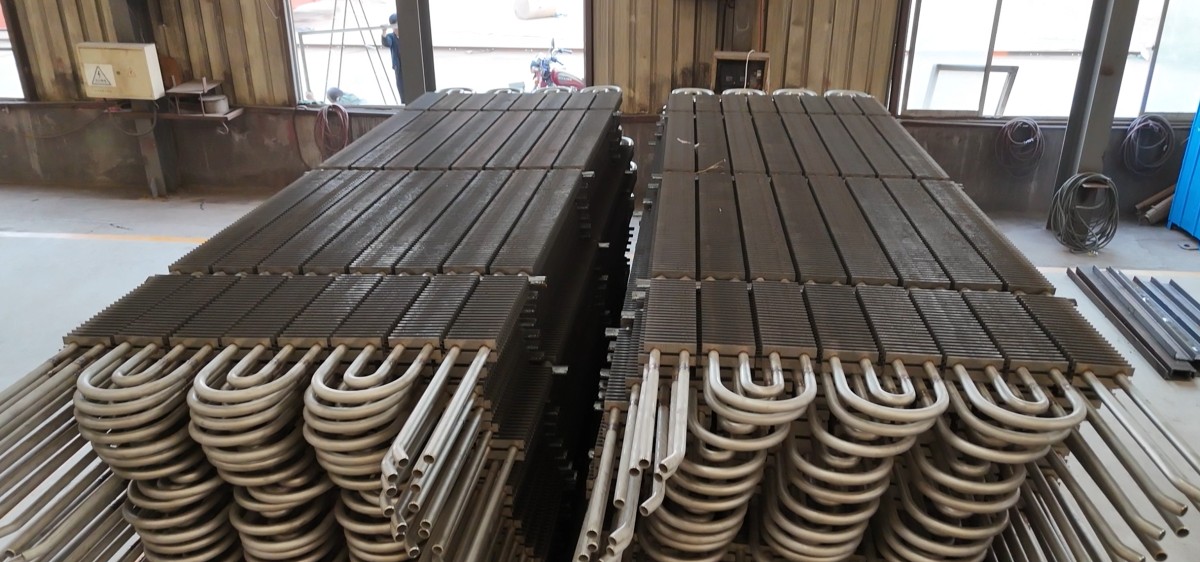
In industrial boilers and waste heat recovery systems, the economizer plays a critical role in improving thermal efficiency and reducing fuel consumption. Among various designs, H-type finned economizer tube panels have become a widely adopted solution due to their high heat transfer efficiency, strong resistance to fouling, and long-term operational reliability.
What Is an H-Type Finned Economizer Tube Panel?
An H-type finned economizer tube panel consists of serpentine tubes with symmetrical H-shaped fins continuously welded onto the outer surface of the tubes. Multiple tubes are assembled into modular panels or bundles, forming the core heat exchange section of the economizer.
Key structural features include:
Serpentine tube arrangement with multiple U-bends to accommodate thermal expansion
H-type fins welded along the tube axis to increase effective heat transfer area
Modular tube panel design for convenient transportation, installation, and maintenance
Flue gas flowing outside the tubes, with water or boiler feedwater flowing inside
Technical Advantages of H-Type Finned Economizer Tubes
1. High Heat Transfer Efficiency
The H-type fin structure significantly increases the external heat transfer surface, allowing more efficient utilization of flue gas waste heat. This design is particularly effective in medium- and low-temperature flue gas sections, where stable and efficient heat recovery is essential.
2. Excellent Anti-Fouling Performance
Compared with spiral fins or densely packed straight fins, H-type fins offer a more open gas flow passage:
Reduced ash accumulation and clogging risk
Stable flue gas pressure drop during long-term operation
Suitable for steam soot blowers or acoustic cleaning systems
These characteristics make H-type finned economizers especially suitable for high-dust and corrosive flue gas environments, such as those found in metallurgical, coking, and cement industries.
3. High Structural Strength and Reliability
H-type fins are typically attached to the base tubes using high-frequency welding or full-penetration welding processes, ensuring:
Strong metallurgical bonding between fins and tubes
High resistance to flue gas erosion and vibration
Reliable performance under thermal cycling and frequent start-stop conditions
This robust structure supports long service life and reduced maintenance requirements.
Typical Applications
H-type finned economizer tube panels are widely used in:
Boiler economizer sections
Waste heat boilers (WHB)
Circulating Fluidized Bed (CFB) boilers
Coke Dry Quenching (CDQ) heat recovery systems
RTO and industrial exhaust gas waste heat recovery units
By preheating boiler feedwater using recovered flue gas heat, these systems help improve overall plant efficiency and reduce operating costs.
Manufacturing and Design Considerations
For reliable long-term operation, H-type finned economizer tube panels are typically manufactured with the following considerations:
Base tube materials selected according to design temperature and pressure requirements
Fully welded fin-to-tube joints to eliminate fin loosening or detachment
Factory-prefabricated tube panels to ensure dimensional accuracy and quality control
Customizable tube diameter, fin thickness, fin pitch, and panel arrangement to match specific operating conditions
Proper design and manufacturing directly affect heat transfer performance, pressure drop, and service life.
Conclusion
As a core component of modern economizer systems, H-type finned economizer tube panels provide an effective balance between heat transfer efficiency, fouling resistance, and mechanical strength. Their proven performance in demanding industrial environments makes them a reliable solution for waste heat recovery and energy-saving applications.
With appropriate material selection, welding technology, and modular design, H-type finned economizers can operate safely and efficiently over long service periods, contributing to reduced fuel consumption and improved overall system performance.
PROFESSIONAL CONSULTATION
If you are interested in our products and want to know more details, please leave a message here, we will reply you as soon as we can.