


Our News
Find out about our latest news here.
Latest News
- ▶ Buying Pressure Vessels from China: How to Read a Q345R and an SA-516 Gr.70 Mill Certificate
- ▶ Boyu Heavy Industry Adds Power Engineering Construction License to Its ASME-Certified Manufacturing Base
- ▶ Inside the Shop: What Those Chalk Marks on a Vessel Mean
- ▶ Gas Turbine HRSG Heating Surfaces: Design, Materials, Finned Tubes and Manufacturing
- ▶ Waste Heat Boilers Explained: Complete Units vs. Heating Surface Modules
- ▶ Sourcing Large Pressure Vessels from China: What Buyers Should Verify Before Awarding
Message
1. Introduction to Large Shell and Tube Condensers
A Large Shell and Tube Condenser is a high-capacity heat exchange device designed to condense vapor into liquid by transferring heat to a cooling medium. With its robust mechanical strength, large heat transfer area, and stable performance under harsh operating conditions, it is widely used in petrochemical plants, refineries, chemical production units, and especially in power generation systems.
In power plants, this type of equipment is typically referred to as a Steam Surface Condenser and serves as a critical component downstream of the steam turbine. In this role, it is also commonly called a Power Plant Condenser, responsible for maintaining vacuum, improving turbine efficiency, and enabling a closed-loop steam cycle.
Whether used in power applications or process industries, the condenser provides excellent reliability, long service life, and high operational efficiency, particularly in large-scale continuous processes.
2. Working Principle of a Steam Surface Condenser
2.1 Indirect Heat Transfer Mechanism
The operating principle of a Steam Surface Condenser is based on indirect heat transfer between two separate fluid streams:
- Vapor (typically steam) enters the shell side, where it spreads over the tube bundle.
- Cooling water flows through the tube side, absorbing heat through the tube walls.
- As the vapor loses heat, it condenses into liquid, which is collected at the bottom of the shell.
- The condensate is either returned to the boiler system or discharged according to process needs.
2.2 Role of Vacuum in a Power Plant Condenser
In a Power Plant Condenser, maintaining deep vacuum is essential. Lower backpressure at the turbine exhaust increases the steam expansion ratio, which directly improves turbine output and overall plant efficiency.
To achieve this, the condenser must:
- Provide rapid and stable condensation of turbine exhaust steam,
- Effectively remove non-condensable gases,
- Maintain structural integrity under vacuum conditions,
- Operate reliably under continuous 24/7 service.

3. Main Components of a Large Shell & Tube Condenser
3.1 Heavy-Duty Shell (Shell Side)
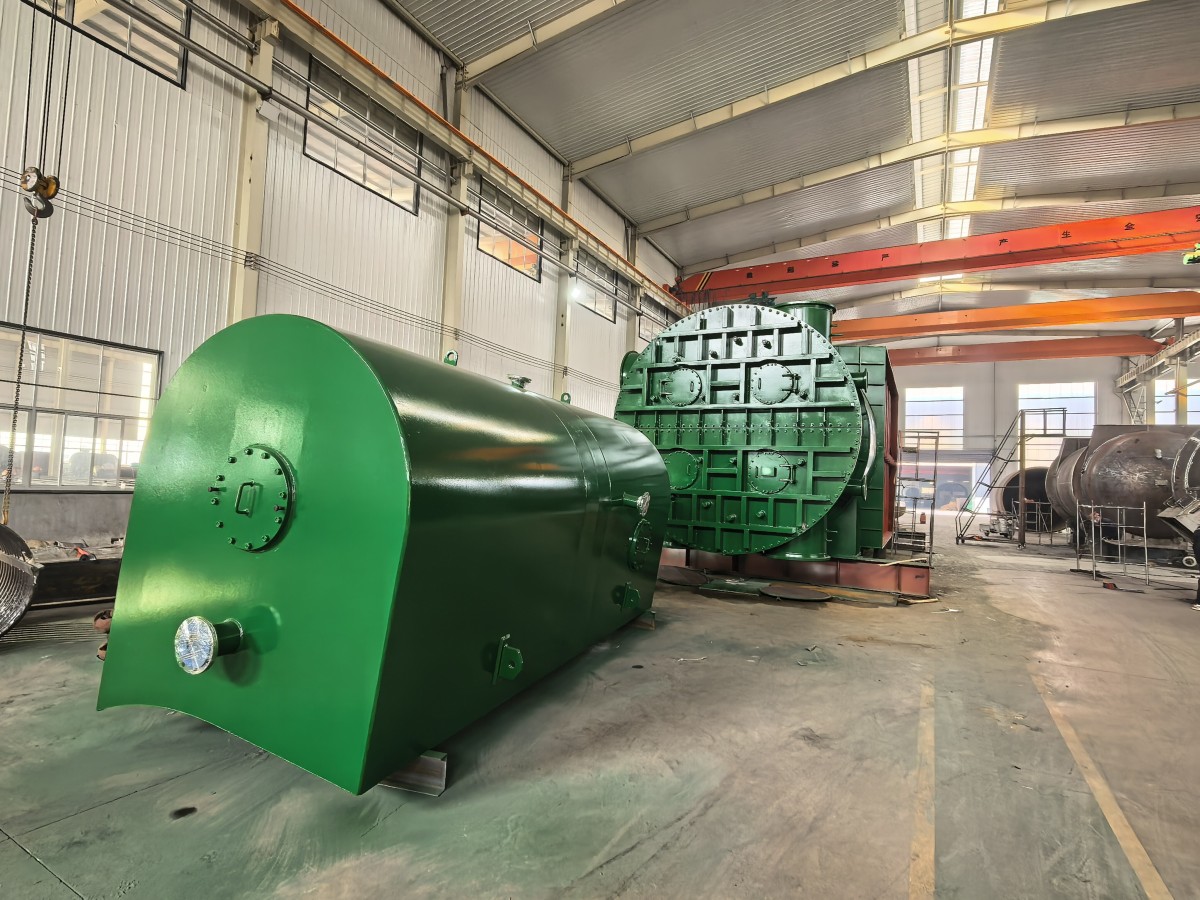
The shell encloses the vapor space and must withstand internal pressure, external vacuum, temperature fluctuations, and thermal expansion. A Large Shell and Tube Condenser typically uses a reinforced cylindrical shell design, especially in power and refinery services where mechanical stability is critical.
3.2 Tube Bundle (Tube Side)
The tube bundle provides the main heat transfer surface. Tube material is selected based on steam conditions, cooling water quality, and corrosion resistance requirements. Common options include:
- Carbon steel
- Stainless steel (304, 316L, 321)
- High-alloy grades such as 904L
- Duplex and super duplex stainless steels
- Titanium (often used in seawater-cooled condensers)
- Nickel-based alloys such as Inconel, Hastelloy, and Monel
In Steam Surface Condensers, the tube bundle must ensure long-term resistance to corrosion and erosion from cooling water, especially in open cooling systems.
3.3 Tube Sheets
Tube sheets are thick plates that support and seal the tube bundle. Precision-drilled tube holes and accurate tube-to-tubesheet joints are crucial. Connection methods may include:
- Mechanical expansion,
- TIG or MIG welding,
- Orbital welding for high-spec or high-pressure designs.
3.4 Baffles and Flow Guides
Baffles are installed inside the shell to direct vapor flow across the tubes, increasing turbulence and improving heat transfer. Proper baffle spacing and configuration significantly influence the performance and pressure drop of a Large Shell and Tube Condenser.
3.5 Nozzles and Process Connections
Inlet and outlet nozzles for steam, condensate, and cooling water are sized and positioned based on flow rate, system layout, and project specifications. For a Power Plant Condenser, the design must also consider turbine exhaust geometry and cooling water system configuration.
4. Key Advantages of Large Shell and Tube Condensers
4.1 High Heat Transfer Capacity
A Large Shell and Tube Condenser offers a large heat transfer area through densely packed tubes, enabling rapid condensation of high steam or vapor loads typical in refineries and power plants.
4.2 Robust Construction for Harsh Conditions
These condensers are engineered to withstand vacuum conditions, water hammer, thermal cycling, and corrosive environments. This robustness is especially important for long-term service as a Power Plant Condenser.
4.3 High Degree of Customization
Manufacturers can tailor design parameters to meet specific process requirements, including:
- Heat duty and steam flow rate,
- Cooling water flow and temperature range,
- Design pressure and allowable pressure drop,
- Material selection and corrosion allowance,
- Layout, nozzle orientation, and installation constraints.
4.4 Maintainability and Serviceability
Access ports, channel heads, and sometimes removable tube bundles make inspection and cleaning easier. This is particularly important where fouling tends to occur, such as in seawater-cooled or process vapor condensers.
4.5 Compatibility with a Wide Range of Media
The condenser can be designed to handle:
- Clean or partially contaminated steam,
- Hydrocarbon vapors in refining applications,
- Corrosive process gases in chemical plants,
- Seawater or industrial cooling water systems.
5. Applications of Steam Surface and Power Plant Condensers
5.1 Power Generation: Steam Surface Condenser
In steam power plants, the Steam Surface Condenser installed below the turbine plays a pivotal role in:
- Maintaining low turbine exhaust pressure,
- Improving thermodynamic efficiency of the Rankine cycle,
- Enabling condensate recovery and closed-loop operation,
- Supporting stable and flexible plant operation.
A reliable Power Plant Condenser directly influences fuel consumption, power output, and overall plant availability.
5.2 Refinery and Petrochemical Services
In refineries and petrochemical complexes, Large Shell and Tube Condensers are widely used to:
- Condense distillation column overhead vapors,
- Provide reflux to fractionation columns,
- Recover hydrocarbons from vapor streams,
- Condense process vapors in various unit operations.
5.3 Chemical Processing Plants
These condensers serve in:
- Solvent vapor recovery,
- Reaction vapor condensation,
- High-purity and specialty chemical production.
5.4 Waste Heat and Energy Recovery
Condensers are also used to recover latent heat from vapor streams, improving overall energy utilization and reducing operating costs in integrated industrial systems.
6. Manufacturing and Quality Control
6.1 Precision Fabrication Techniques
The manufacture of a Large Shell and Tube Condenser requires advanced fabrication capabilities, including:
- CNC machining for tube sheets and flange faces,
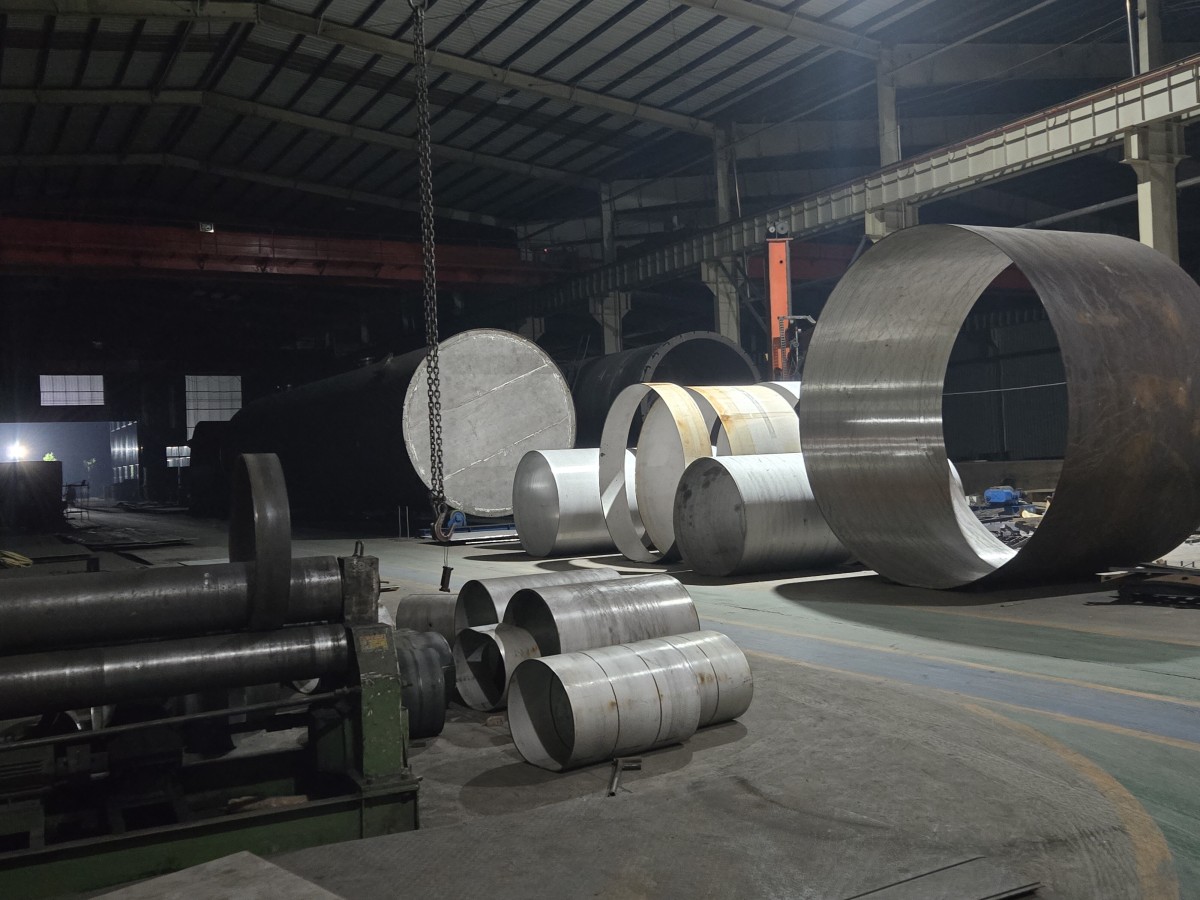
- Shell rolling and longitudinal seam welding,
- Automatic or orbital welding for critical joints,
- Hydraulic tube expansion and/or tube-to-tubesheet welding,
- Accurate dimensional control and alignment.
6.2 Mechanical and Thermal Testing
Typical testing programs for Steam Surface Condensers and Power Plant Condensers include:
- Hydrostatic pressure tests for shell and tube side,
- Vacuum leak tests to confirm tightness under negative pressure,
- Air or helium leak detection for critical applications,
- Nondestructive tests (RT, UT, PT, MT) on welds,
- Positive material identification (PMI) of critical components.
6.3 Compliance with International Standards
Condensers are generally designed and fabricated in accordance with:
- ASME Boiler and Pressure Vessel Code, Section VIII,
- TEMA standards (R, C, or B class),
- ISO 9001 quality management systems,
- CE/PED and other regional regulations when required.
7. Why Choose a Large Shell and Tube Condenser
Selecting a Large Shell and Tube Condenser is the preferred option when your plant requires:
- Very high steam or vapor flow capacity,
- Continuous operation with minimal downtime,
- High vacuum or high-pressure operating conditions,
- Reliable condensation of corrosive or fouling media,
- Maximum energy efficiency and heat recovery.
In power generation, a well-designed Steam Surface Condenser or Power Plant Condenser is a strategic asset that enhances plant performance and reduces lifecycle cost.
8. Conclusion
Large Shell and Tube Condensers, including their specialized roles as Steam Surface Condensers and Power Plant Condensers, play an essential role in modern energy and process industries. They provide high heat transfer performance, mechanical robustness, long service life, and strong adaptability to various media and operating conditions.
By combining sound thermal and mechanical design, appropriate material selection, precision manufacturing, and rigorous quality control, these condensers enable safe, efficient, and sustainable operation in demanding industrial environments.
PROFESSIONAL CONSULTATION
If you are interested in our products and want to know more details, please leave a message here, we will reply you as soon as we can.