


Our News
Find out about our latest news here.
Latest News
- ▶ Spiral Plate vs Shell and Tube Heat Exchanger: Which One Fits Your Duty?
- ▶ CDQ Waste Heat Boilers: What Governs the Design, and What Actually Breaks
- ▶ What Are the Heating Surfaces in a Waste Heat Boiler? Superheater, Evaporator and Economizer Explained
- ▶ Buying Pressure Vessels from China: How to Read a Q345R and an SA-516 Gr.70 Mill Certificate
- ▶ Boyu Heavy Industry Adds Power Engineering Construction License to Its ASME-Certified Manufacturing Base
- ▶ Inside the Shop: What Those Chalk Marks on a Vessel Mean
Message
1. Overview
An Aeration Heat Exchanger (also known as an Air-assisted Gas Cooler) is a type of gas treatment equipment that utilizes air injection (aeration) to participate in the heat exchange process.
Its core function is:
To reduce gas temperature, homogenize flow, and adjust gas composition through air-induced convective heat transfer.
Compared with conventional water-cooled heat exchangers, aeration heat exchangers offer advantages such as lower operating cost, simpler structure, and higher tolerance to complex gas conditions.
2. Working Principle
The aeration heat exchanger operates based on a combination of:
Gas–gas heat transfer
Forced convection enhancement
Mixing and dilution effects
2.1 Air Injection (Aeration)
Ambient air is introduced into the system via fans or natural draft and mixed with the process gas.
2.2 Convective Heat Transfer
The introduced air absorbs heat from the high-temperature gas, resulting in:
Temperature reduction
Enhanced turbulence and heat transfer efficiency
2.3 Gas Mixing and Dilution
Simultaneously, the process achieves:
Uniform gas distribution
Reduction of combustible gas concentration
Adjustment of oxygen content
3. Structural Features
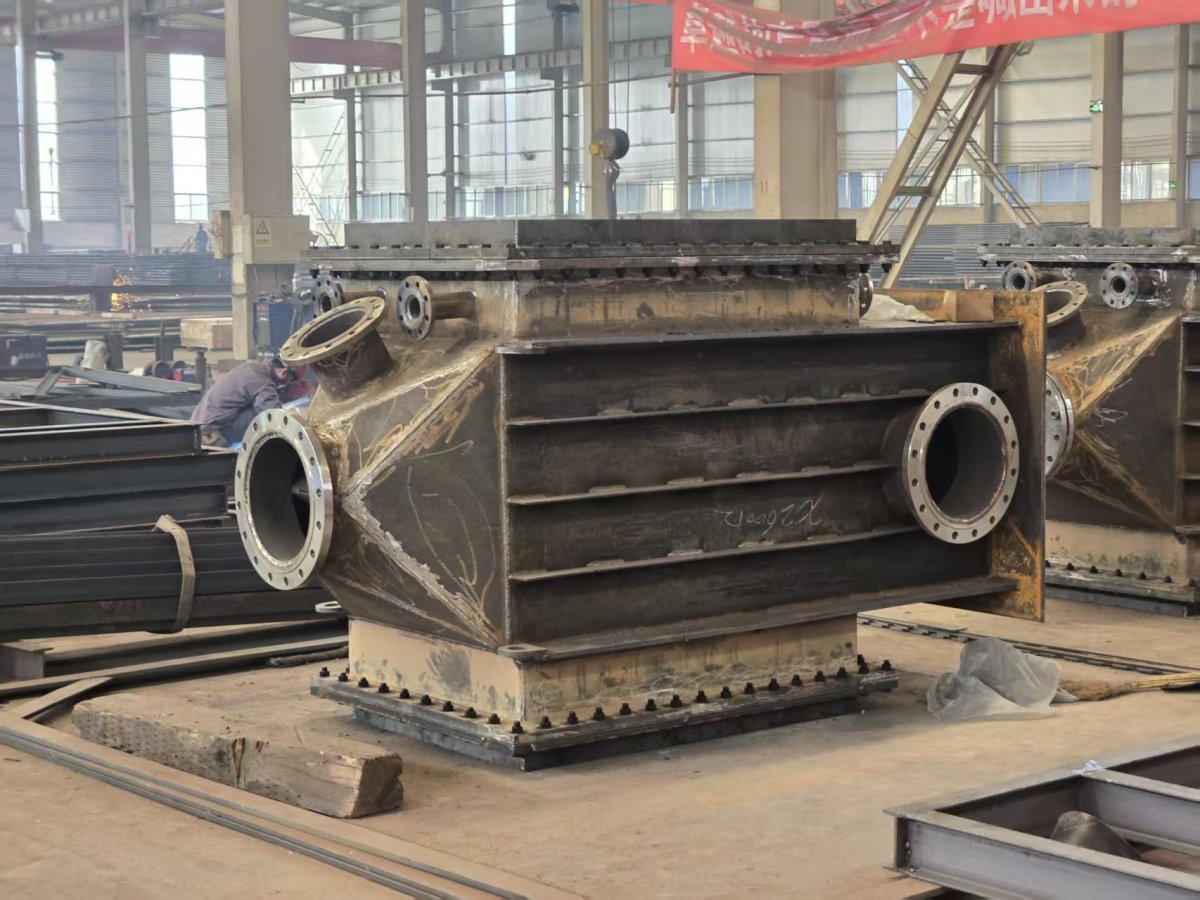
A typical aeration heat exchanger adopts a box-type or shell structure, consisting of:
▪ Main Shell
Provides the enclosure for gas flow and heat exchange
Usually fabricated from carbon steel or stainless steel
▪ Internal Baffles
Multi-layer arrangement
Extends flow path and increases turbulence
Improves heat transfer performance
▪ Gas Inlet and Outlet Nozzles
Large-diameter flanged connections
Designed for high flow-rate gas handling
▪ Air Injection Ports
Introduce ambient air into the system
Can be equipped with control valves or fans
▪ Inspection and Instrumentation Ports
Temperature and pressure measurement points
Venting and maintenance access
4. Technical Advantages
✔ Low Operating Cost
No need for circulating cooling water system
Reduced water treatment and utility cost
✔ Simple and Robust Structure
No tube bundles
Lower risk of fouling and blockage
✔ High Adaptability
Suitable for gases containing dust, tar, or corrosive components
✔ Enhanced Safety
Dilutes combustible gases
Reduces explosion risk
✔ Energy Efficient and Environmentally Friendly
Eliminates water consumption
Reduces overall energy usage
5. Typical Applications
5.1 Coking and By-product Recovery
Coke oven gas pre-cooling
Gas conditioning before primary cooling
5.2 VOCs Treatment Systems (e.g., RTO Front-end)
High-temperature gas cooling
Oxygen content adjustment
5.3 Flue Gas Treatment
Temperature equalization
Protection of downstream equipment
5.4 Power and Energy Industry
Gas pre-treatment systems
Auxiliary cooling units
6. Comparison with Conventional Heat Exchangers
7. Key Design Considerations
When designing an aeration heat exchanger, the following parameters are critical:
Inlet gas temperature and flow rate
Target outlet temperature
Air injection rate (aeration volume)
Pressure drop control
Material selection (corrosion & temperature resistance)
Explosion-proof and safety design
8. Conclusion
The aeration heat exchanger is a cost-effective, reliable, and flexible solution for gas cooling and conditioning. It is particularly suitable for industries where:
Water resources are limited
Gas composition is complex
Fouling risk is high
PROFESSIONAL CONSULTATION
If you are interested in our products and want to know more details, please leave a message here, we will reply you as soon as we can.