


01 What is an HRSG heating surface?
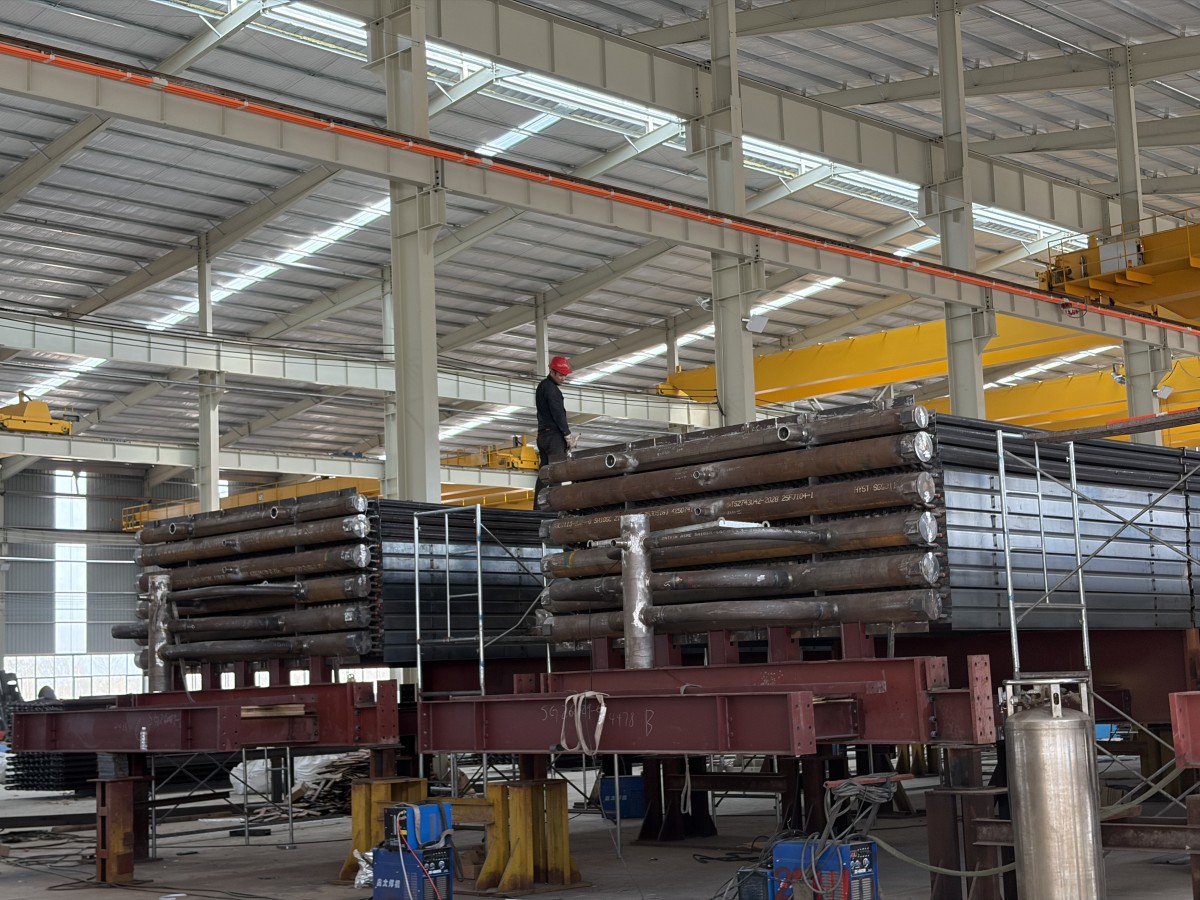
An HRSG (Heat Recovery Steam Generator) sits behind a gas turbine and recovers heat from its hot exhaust to raise steam. The heating surface is the tube-bundle section where that exhaust gas exchanges heat with the working fluid — water and steam. It is the part that performs the heat recovery itself.
In operation, gas flows across the outside of the tube bundles while water inside the tubes is heated, evaporated, and superheated into usable steam. How efficiently a heating surface transfers heat, and how well it resists corrosion and fatigue, directly sets the output, efficiency, and reliability of the whole unit.
02 The four heating surfaces
Arranged along the gas path, from the hottest zone to the coolest.
- 1
Superheater SH
Placed in the hottest gas zone, it raises saturated steam to superheated steam, improving steam quality and work output. Because of the high temperature, it demands the most from material high-temperature strength and oxidation resistance.
- 2
Reheater RH
Reheats steam after it has expanded through the HP turbine, before it returns to the IP/LP turbine, lifting overall cycle efficiency. Its operating conditions are close to those of the superheater.
- 3
Evaporator EVA
Handles the boiling of water and absorbs the largest share of heat, working with a drum or separator for steam–water separation. It carries the most tubes and the largest surface area — the biggest module in the HRSG.
- 4
Economizer ECO
Sits at the cool tail end, using low-temperature gas to preheat feedwater, lowering the stack temperature and raising overall efficiency. Low-temperature dew-point corrosion needs special attention here.
03 How a heating surface is built
A typical module is made of four building blocks.
Headers
Thick cylindrical vessels that collect and distribute the working fluid. Inlet headers feed the tubes; outlet headers gather flow back. Capped at each end and drilled with many stub connections, they are the key pressure part of the surface.
Heat-transfer tubes
The many parallel tubes that link inlet and outlet headers and carry out the heat exchange. They are bent into serpentine (coil) shapes to extend the heated length inside the gas duct.
Fins
Spiral fins are wound or welded onto the tube walls to enhance gas-side heat transfer. This large added surface area is the feature that most clearly distinguishes HRSG surfaces from bare-tube fired-boiler surfaces.
Frame & casing
Tube bundles are assembled into liftable, shippable module units with a steel frame, side casing (seal plates), and support beams for fast site installation.
04 Common materials
Selection follows operating temperature, pressure, and medium corrosivity.
05 The manufacturing process
A heating surface is a pressure part, so process control is demanding throughout.
- Cutting & bevel prep. Headers and tubes are cut to drawing and weld bevels machined.
- Tube bending. Tubes are bent into serpentine or U shapes, controlling bend radius and ovality to keep wall thinning within limits.
- Fin welding. Spiral fins are continuously high-frequency resistance welded to the base tube, ensuring weld penetration and fin bond strength.
- Header drilling & stub welding. Holes are drilled in the header and tubes welded on — the highest-volume and most critical welding stage of the whole surface.
- Module assembly. Tube rows, headers, frame, and casing are assembled into a complete module, with pitch and flatness corrected.
- Non-destructive testing. Pressure welds are checked by RT, UT, and PT to confirm there are no cracks or lack of fusion.
- Hydrostatic test. The unit is pressure-tested at design pressure to verify strength and tightness.
- Cleaning & preservation. Tubes are blown, pickled, oil-sealed, and packed for transport and site installation.
Every step should carry a traceable quality record. Critical welds must be made by certified welders and pass inspection — that is what keeps a heating surface safe through years of high-temperature, high-pressure, cyclic service.
06 Selection & quality checkpoints
What to watch when buying or building HRSG heating surfaces.
- Material certs & re-checks — match the mill certificate, and spectrometer-verify where needed to rule out wrong material.
- Weld quality — stub-to-header welds are a leak hotspot; control welding parameters and NDT coverage tightly.
- Fin bond strength — loose or detached fins cut heat transfer and cause local overheating.
- Module dimensional accuracy — affects site fit-up and sealing; plan transport and lifting deliberately.
- Corrosion & dew-point control — especially the cold economizer stage, designed out through proper temperature margins.
07 Frequently asked questions
How is an HRSG heating surface different from a conventional boiler?
The biggest difference is finned (extended-surface) tubing to boost gas-side heat transfer, plus modular fabrication and installation. Conventional fired boilers mostly use bare-tube water walls.
What does an HRSG heating surface include?
Mainly the superheater, reheater, evaporator, and economizer — each built from headers, heat-transfer tubes, fins, and a module frame.
Where do failures most often occur?
Header stub welds, fin welds, and the low-temperature corrosion zone of the economizer are the common high-risk areas to monitor in both fabrication and service.
What materials are used for HRSG heating surfaces?
From low to high temperature: carbon steel, low-alloy heat-resistant steel (15CrMo, T22), and austenitic stainless steel (TP347H). The exact grade is set by the design drawing.
08 In summary
The HRSG heating surface is the heart of heat recovery in a combined-cycle plant, and its types, structure, material selection, and manufacturing are tightly linked. Only by controlling quality across the full chain — from design selection through welding, inspection, and testing — can a heating surface run reliably for years. For buyers and manufacturers alike, understanding these fundamentals leads to sharper, more confident decisions.