

Our News
Find out about our latest news here.
Latest News
- ▶ Spiral Plate vs Shell and Tube Heat Exchanger: Which One Fits Your Duty?
- ▶ CDQ Waste Heat Boilers: What Governs the Design, and What Actually Breaks
- ▶ What Are the Heating Surfaces in a Waste Heat Boiler? Superheater, Evaporator and Economizer Explained
- ▶ Buying Pressure Vessels from China: How to Read a Q345R and an SA-516 Gr.70 Mill Certificate
- ▶ Boyu Heavy Industry Adds Power Engineering Construction License to Its ASME-Certified Manufacturing Base
- ▶ Inside the Shop: What Those Chalk Marks on a Vessel Mean
Message
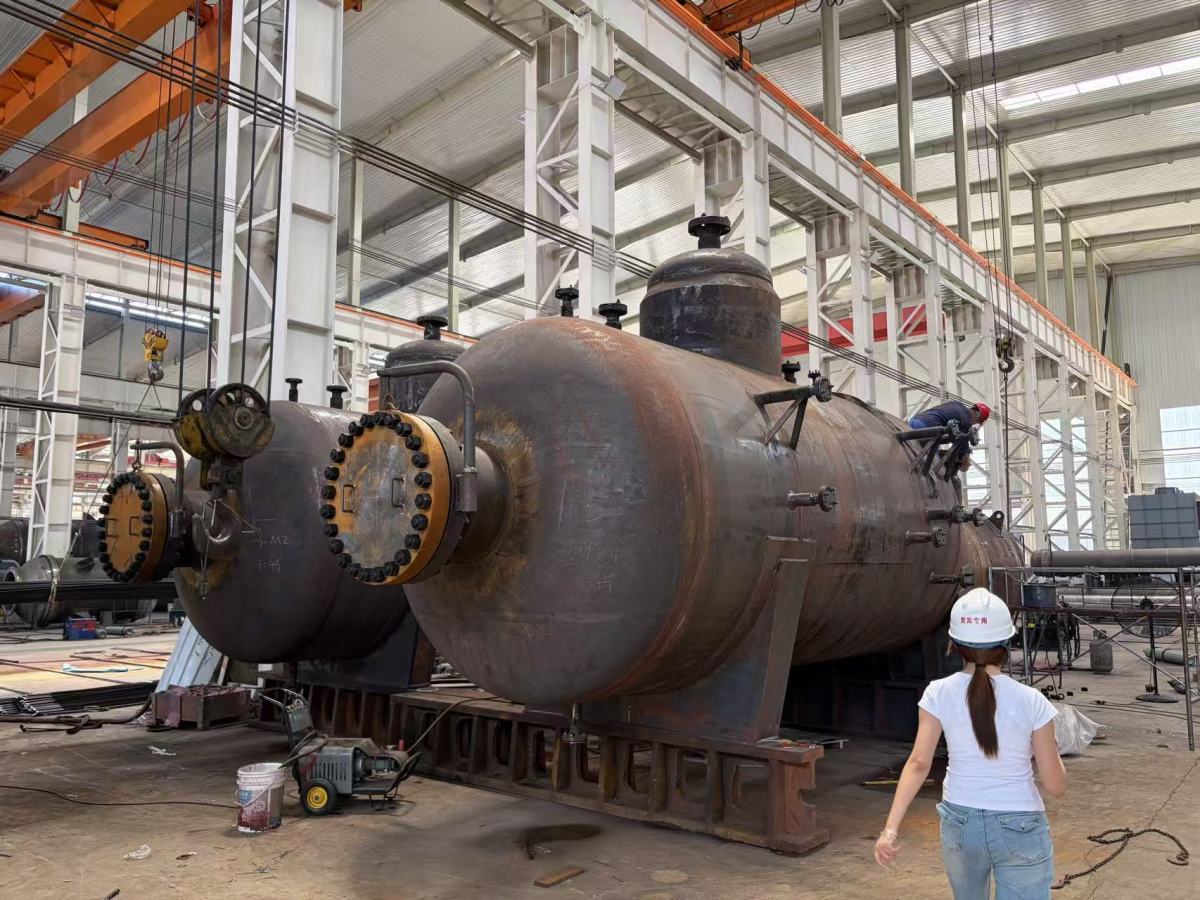
A pressure vessel is not a commodity purchase. Once a shell exceeds roughly 3 metres in diameter and 40 tonnes in weight, it can no longer be assembled on site from parts — it must be rolled, welded, heat treated, tested and shipped as a single unit. The fabricator's workshop crane capacity, furnace dimensions and road clearance become as decisive as its price.
This article covers what actually goes into building a large vessel, what the certification alphabet means in practice, and the questions that separate a capable fabricator from a broker with a nice brochure.
Equipment Categories
- Shell-and-tube heat exchangers — the workhorse of refining, petrochemical and power plants
- Separators, knock-out drums, surge vessels — core to oil and gas processing trains
- Reactors and columns — chemical synthesis and distillation service
- HRSG heating surfaces, steam drums, economizers, superheaters — waste heat recovery and power generation
How a Large Vessel Is Actually Built
Material receipt and verification. Every pressure-retaining plate, forging and tube arrives with a mill test certificate. For ASME scope, materials must be Code-listed grades — SA-516 Gr.70, SA-105N, SA-106B, SA-240 and so on — with marking transfer witnessed and full traceability maintained through fabrication. Weak traceability is the single most common finding in vendor audits.
Cutting and shell rolling. Plates are CNC-cut to development drawings, bevelled, then rolled. Heavy-wall courses demand serious plate roll tonnage; the roundness and peaking achieved here dictate whether the fit-up downstream will be clean or a fight.
Head forming. Large-diameter heads are spun in one piece or pressed in segments and welded. Thinning ratio and profile deviation are checked after forming, and post-forming heat treatment may be required to restore material properties.
Longitudinal and circumferential welding. Long seams first, then circ seams during course assembly — the usual sequence for holding roundness. Submerged arc welding with double-sided profiling is standard on heavy sections. Every welder and every procedure must be qualified to ASME Section IX (PQR/WPS) before an arc is struck.
Nozzles, flanges and internals. Manways, nozzles, saddles and lifting lugs are fitted per drawing. For exchangers, this stage also covers tubesheet drilling, tube insertion and tube-to-tubesheet joints — strength weld, seal weld, or expanded-and-welded. This is where process discipline shows most clearly.
Post-weld heat treatment. Heavy-wall carbon steel, hydrogen service and wet H₂S service normally require full stress relief. The complete thermal cycle — ramp rates, soak time, cooling — is chart-recorded and forms part of the delivered documentation.
NDE and pressure testing. RT, UT, PT and MT per design requirements, followed by hydrostatic or pneumatic testing. On ASME scope, the Authorized Inspector witnesses designated hold points and signs the U-1A data report.
Surface preparation, nameplate and shipment. Blasting, painting, nameplate stamping and fixing, then oversize transport permitting and dispatch.
What the Certificates Mean — and Don't
ASME U stamp. Authorization to build to Section VIII Div. 1, granted after a joint review of the quality system and maintained under continuous third-party AI oversight. For most North American, Middle East and Southeast Asian projects, it's a bid prerequisite rather than a differentiator.
ASME S stamp. Section I power boiler scope, covering boilers and their pressure parts.
Chinese Class A boiler licence and A2/A3 pressure vessel licences. The upper tiers of China's special equipment manufacturing licence system, covering high-pressure vessels and spherical storage among other categories.
ISO 9001 / 14001 / 45001. Quality, environmental and occupational health and safety management systems — standard checklist items in any vendor audit.
The caveat most buyers miss: every one of these licences carries a defined scope — pressure range, material group, volume, temperature. A valid certificate does not mean the holder is authorized to build your equipment. Ask for the scanned certificate and read the scope annex, not just the cover page.
Six Questions That Actually Qualify a Fabricator
- Does the certificate scope cover my design conditions? Check pressure, material and volume limits against your datasheet.
- Where is the comparable reference? Same tonnage, same material, same service. A verifiable project list beats a capability statement.
- Can the workshop physically handle the unit? Bay height, crane capacity, PWHT furnace dimensions, and the width of the road out of the plant. Equipment that can be built but not moved is a failed project.
- How deep is the existing PQR library? Broad pre-qualified coverage means faster mobilization and fewer surprises at kickoff.
- Can they produce the documentation package? An export vessel dossier runs to hundreds of pages. Document defects delay shipment as often as weld defects do.
- Will they host a resident TPI? Fabricators comfortable with full-process witnessing are usually the ones with nothing to hide.
About Shandong Boyu Heavy Industry
Shandong Boyu Heavy Industry Technology Group Co., Ltd. is located in Xintai City, Shandong Province, China, specializing in pressure vessels, shell-and-tube and spiral plate heat exchangers, and boiler pressure parts. The company holds ASME "U" and "S" Certificates of Authorization, a Class A boiler manufacturing licence, A2/A3 pressure vessel manufacturing licences, and ISO 9001 / 14001 / 45001 certification.
Boyu operates one of China's largest serpentine tube production bases, supplying HRSG heating surfaces, economizers, superheaters and air preheaters alongside process heat transfer equipment. Delivered projects span Southeast Asia, Central Asia, the Middle East, South Asia, Africa and South America, serving both international EPC contractors and end users directly.
PROFESSIONAL CONSULTATION
If you are interested in our products and want to know more details, please leave a message here, we will reply you as soon as we can.