

Our News
Find out about our latest news here.
Latest News
- ▶ EAC Certification for Chinese Pressure Vessels: What It Takes to Export Under TR CU 032/2013
- ▶ Spiral Plate vs Shell and Tube Heat Exchanger: Which One Fits Your Duty?
- ▶ CDQ Waste Heat Boilers: What Governs the Design, and What Actually Breaks
- ▶ What Are the Heating Surfaces in a Waste Heat Boiler? Superheater, Evaporator and Economizer Explained
- ▶ Buying Pressure Vessels from China: How to Read a Q345R and an SA-516 Gr.70 Mill Certificate
- ▶ Boyu Heavy Industry Adds Power Engineering Construction License to Its ASME-Certified Manufacturing Base
Message
In September 2026, Shandong Boyu Heavy Industry Technology Group received two new conformity documents for pressure equipment destined for the Eurasian Economic Union (EAEU): an EAC Certificate of Conformity for a low-temperature gas reboiler and an EAC Declaration of Conformity for a welded plate heat exchanger. Both were issued under TR CU 032/2013, "On the Safety of Equipment Operating Under Excess Pressure".
A question we hear often from buyers in Russia, Kazakhstan, Uzbekistan and the wider region is: can equipment designed and built in China to Chinese codes actually get EAC approval? The short answer is yes. This article explains how, based on our own recent projects.
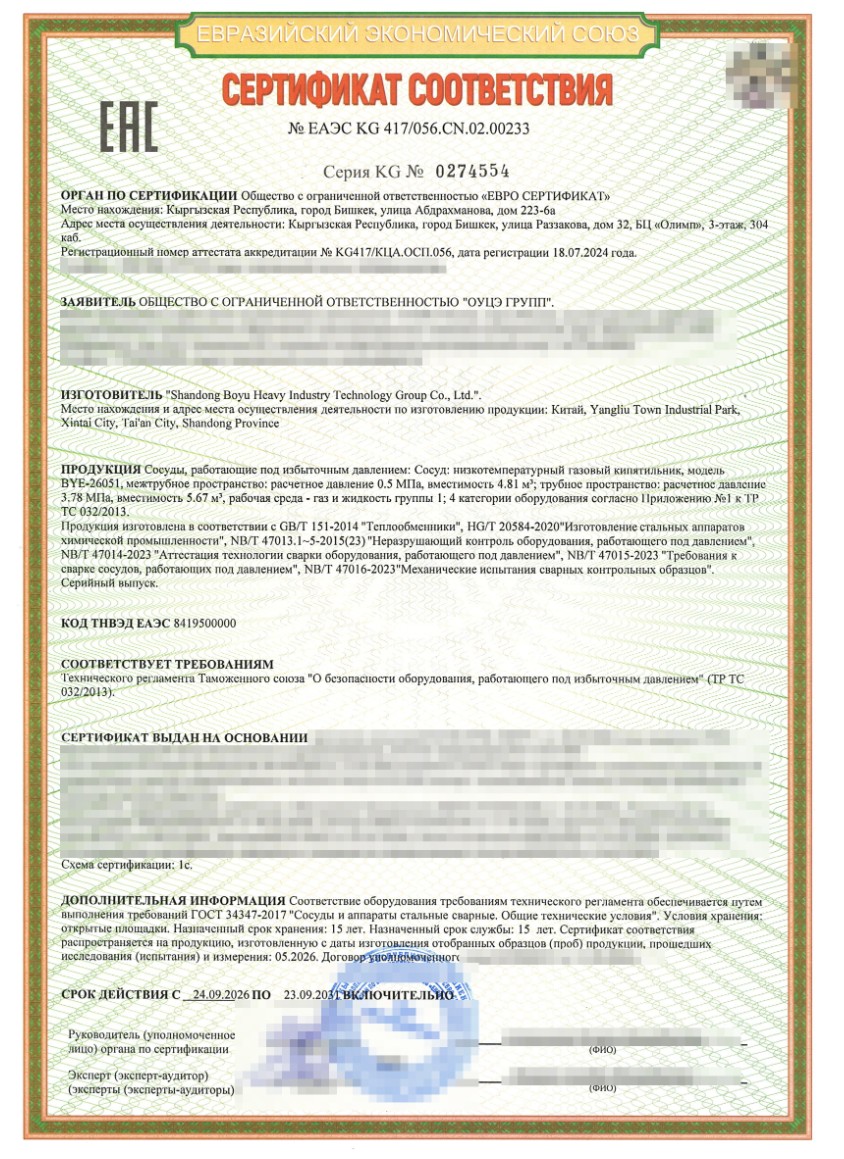
EAC certificate of conformity TR CU 032/2013 for a Chinese-manufactured pressure vessel (reboiler)
What TR CU 032/2013 covers
TR CU 032/2013 is the EAEU technical regulation for pressure equipment. It applies across Russia, Kazakhstan, Belarus, Armenia and Kyrgyzstan, and equipment that complies with it carries the EAC mark. It covers vessels, heat exchangers, boilers, piping components and pressure accessories operating above 0.05 MPa.
Without a valid EAC document, pressure equipment generally cannot clear customs into the EAEU or be put into service there. For project buyers, the EAC document is usually requested at the bidding stage, long before shipment.
Certificate or declaration? It depends on the hazard category
Every piece of pressure equipment is assigned a hazard category (1 to 4) based on the working medium group, design pressure and volume (or nominal diameter for piping). The category decides which conformity route applies:
Our two recent cases illustrate both routes:
- Low-temperature gas reboiler — Certificate (scheme 1c). Shell side 0.5 MPa, tube side 3.78 MPa, Group 1 gas and liquid medium. The combination of pressure, volume and medium placed it in Category 4, so full certification with production analysis was required.
- Welded plate heat exchanger — Declaration (scheme 1d). A lower hazard category allowed the declaration route, supported by an accredited laboratory test protocol.
Both documents are valid for five years and cover serial production.
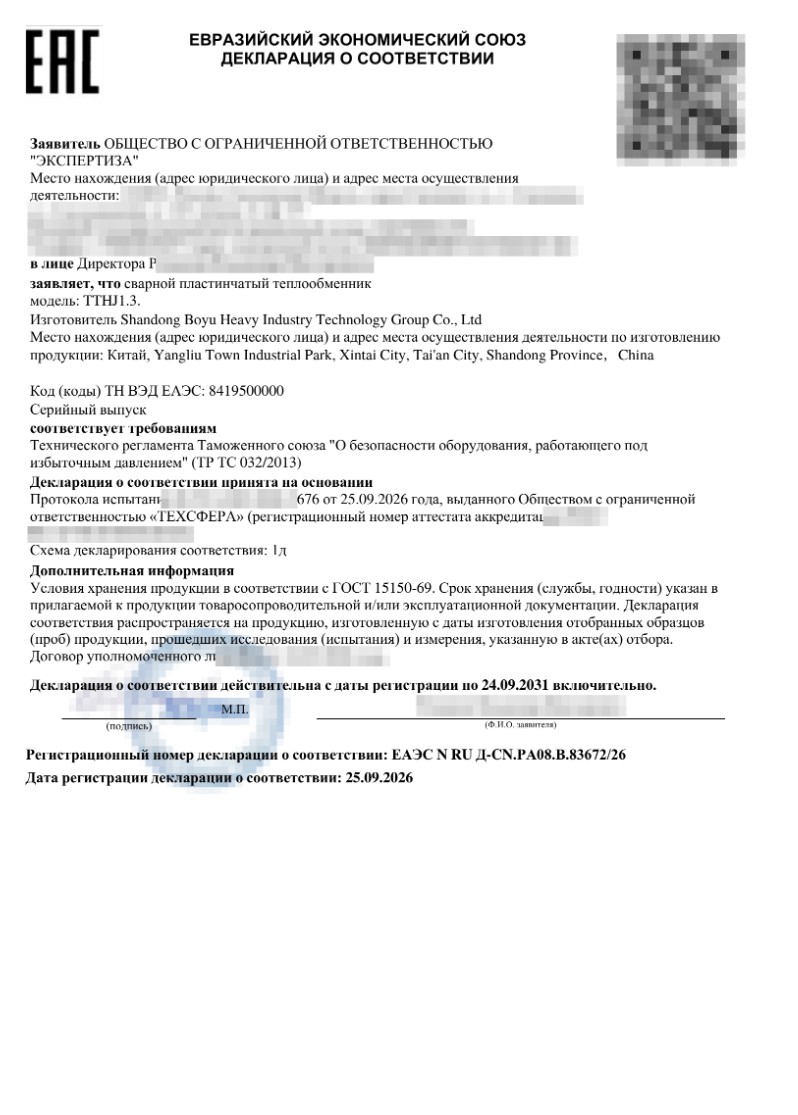
EAC declaration of conformity TR CU 032/2013 for a welded plate heat exchanger made in China
Yes, Chinese codes are accepted
A common misconception is that EAC approval requires designing to GOST from scratch. It does not. TR CU 032/2013 sets essential safety requirements. It does not mandate a single design code. What the certification body needs is evidence that the design, materials and fabrication achieve the required level of safety.
Our certified reboiler was designed and fabricated to Chinese standards, and these are listed directly on the certificate:
- GB/T 151 — Heat exchangers
- HG/T 20584 — Fabrication of steel chemical vessels
- NB/T 47013 — Non-destructive testing of pressure equipment
- NB/T 47014 / 47015 / 47016 — Welding procedure qualification, welding of pressure vessels, and mechanical testing of welded coupons
Conformity with TR CU 032/2013 is then confirmed through GOST 34347-2017 (welded steel vessels and apparatus, general technical conditions), which the certificate references as the harmonized standard.
For clients who prefer it, the same logic applies to equipment built to ASME Section VIII. Boyu holds ASME U and S stamps, so either design basis is available.
Materials: GB or ASME, both workable
Material selection is one of the first questions EAEU buyers ask. Both routes are workable:
- GB materials (for example Q245R, Q345R, S30408 and other grades under GB/T 713 / GB/T 24511) can be used, provided the mechanical properties at design temperature support the strength calculation.
- ASME materials (for example SA-516 Gr.70, SA-240 304/316L, SA-179/SA-213 tubes) are equally acceptable and are often preferred when the end user's specification is based on international codes.
What matters is traceability. Every pressure-retaining part must be backed by mill certificates that can be matched to the material used in the calculation and to the physical part. Where the end user thinks in GOST grades, a material cross-reference to the nearest GOST equivalent helps the review go smoothly.
What you actually have to submit
This is where most of the work lies. For the certificate in our reboiler project, the certification body reviewed the following package:
- Thermal design calculation. Heat duty, heat transfer area, and operating conditions on both sides. This establishes that the design parameters stated in the documents reflect how the equipment will actually run.
- Strength calculation. Wall thickness of shells, heads, tubesheets and nozzles at design pressure and temperature, based on the chosen code and materials.
- Safety justification ("Obosnovanie bezopasnosti"). A document specific to EAC. It identifies hazards over the equipment's life, the measures taken against them, and the assigned service life. In our case this is 15 years.
- Design drawings.
- Equipment passport ("Pasport"). The formal record of design data, materials, test results and manufacturer's declarations. It ships with the equipment.
- Operation manual. Covers installation, operation, maintenance and decommissioning.
- Factory test reports. Hydrostatic test, NDT reports, and mechanical test results.
- Personnel qualification records. Qualification of welders and NDT personnel.
- Test protocol from an accredited laboratory, plus, for scheme 1c, an audit of production conditions by the certification body.
In other words, EAC certification is essentially a check that a complete, consistent quality dossier exists. A manufacturer that already runs a disciplined ASME or Chinese TSG quality system has most of these documents. The extra work is the safety justification, the passport format, and making sure every figure matches across calculation, drawing and passport.
Practical points buyers should know
- An EAEU-registered applicant is required. The applicant named on the certificate or declaration must be a legal entity in an EAEU member state. Chinese manufacturers therefore work through an authorized representative under contract. The certification body itself can be in any member state; our certificate, for example, was issued by a body in Kyrgyzstan.
- The document is equipment-specific. A certificate covers the named product type and parameters, not "all pressure vessels from this factory". New designs with different parameters may need their own document or an extension.
- Russian-language documentation. The passport and operation manual delivered with the equipment must be in Russian (plus the state language where required).
- EAC marking on the nameplate. Once the document is registered, the EAC mark and the required data go on the nameplate.
- Plan it into the schedule. Start EAC work early, ideally in parallel with detailed design. A late start is a common cause of shipment delays.
Why this matters for Boyu's clients
For buyers in the EAEU, working with a manufacturer that has already taken equipment through TR CU 032/2013 removes a major project risk. We know what the certification body will ask for, and we prepare calculations, dossiers and passports with EAC review in mind from day one.
The same project team also runs Boyu's ASME and Chinese-code work. Our credentials include:
- ASME U and S stamps
- Class A boiler and A2/A3 pressure vessel manufacturing licences
- ISO 9001 / 14001 / 45001 certification
- In-house digital radiography (DR) for weld examination
Whether your specification is based on GB, ASME or GOST, we can build to it and document it for EAC.
FAQ
Can a pressure vessel made in China receive EAC certification?Yes. TR CU 032/2013 does not require the equipment to be made in the EAEU or designed to GOST. Chinese-built equipment designed to GB/T or ASME codes can be certified if the technical dossier demonstrates compliance with the regulation's essential safety requirements.
Does EAC accept GB or ASME materials?Yes. Both GB and ASME materials can be used. The key is full material traceability through mill certificates, and a strength calculation that uses the material's properties at design temperature.
What is the difference between an EAC certificate and an EAC declaration for pressure equipment?Higher hazard categories require a certificate issued by an accredited certification body. Lower categories can use a declaration made by the applicant, based on accredited laboratory testing. Both are entered in the EAEU unified register.
How long is an EAC certificate for pressure equipment valid?For serially produced equipment, the certificate or declaration is typically valid for up to five years. Both of Boyu's current documents are valid until 2031.
What documents are needed for TR CU 032/2013 certification?Typically: thermal and strength calculations, a safety justification, drawings, the equipment passport, an operation manual, factory test and NDT reports, welder and NDT personnel qualifications, and test protocols from an accredited laboratory.
PROFESSIONAL CONSULTATION
If you are interested in our products and want to know more details, please leave a message here, we will reply you as soon as we can.