


Our News
Find out about our latest news here.
Latest News
- ▶ Spiral Plate vs Shell and Tube Heat Exchanger: Which One Fits Your Duty?
- ▶ CDQ Waste Heat Boilers: What Governs the Design, and What Actually Breaks
- ▶ What Are the Heating Surfaces in a Waste Heat Boiler? Superheater, Evaporator and Economizer Explained
- ▶ Buying Pressure Vessels from China: How to Read a Q345R and an SA-516 Gr.70 Mill Certificate
- ▶ Boyu Heavy Industry Adds Power Engineering Construction License to Its ASME-Certified Manufacturing Base
- ▶ Inside the Shop: What Those Chalk Marks on a Vessel Mean
Message
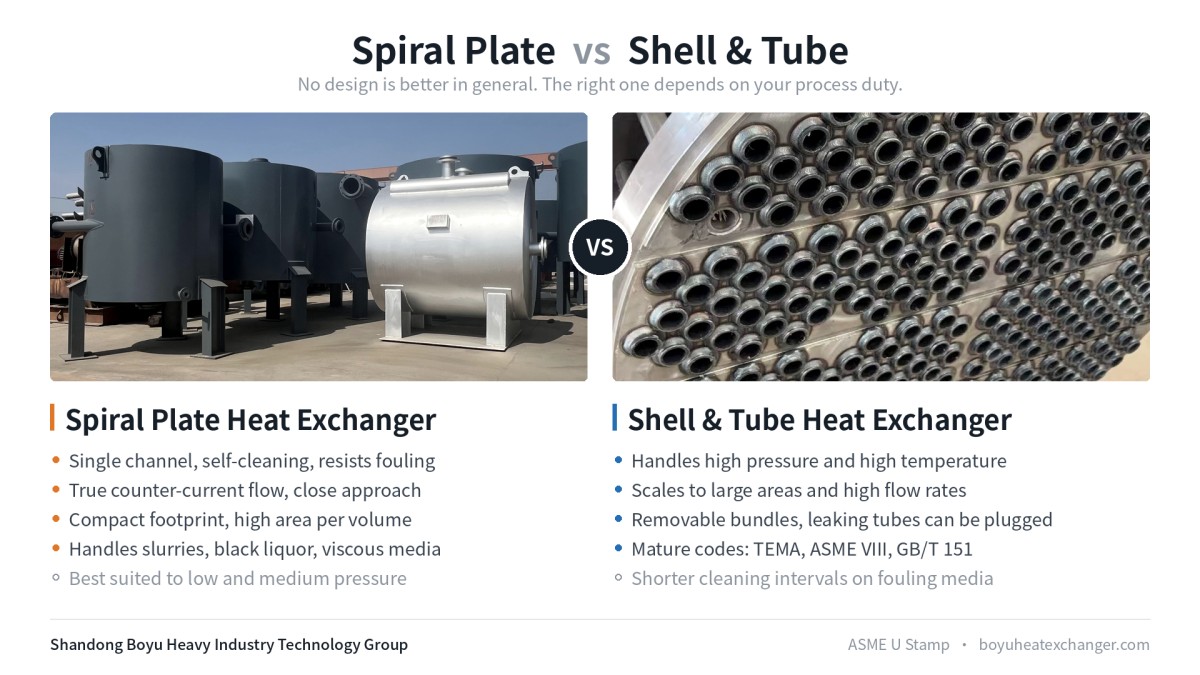
In refining, petrochemicals, pulp and paper, metallurgy and wastewater treatment, heat exchanger selection has a direct impact on run length and maintenance cost. The shell and tube heat exchanger is the most established design in industry. The spiral plate heat exchanger, on the other hand, earns its place in the difficult services where conventional units struggle. Neither is better in general. The right choice depends on the fluids and the operating conditions. This guide compares the two designs point by point and ends with practical selection advice.
1. How They Are Built: One Channel vs a Bundle of Tubes
A spiral plate heat exchanger is made by rolling two metal plates around a central core. This forms two separate, concentric spiral channels, one for each fluid. Studs welded to the plates keep the channel spacing constant. There are three common flow arrangements:
- Type I: both fluids flow spirally, giving true counter-current flow. Suited to liquid-liquid duties.
- Type II: one fluid flows spirally and the other flows axially. Suited to condensing and vaporizing.
- Type III: a combination design that condenses and subcools in one unit.
A shell and tube heat exchanger consists of a shell, a tube bundle, tubesheets, baffles and channel heads. One fluid flows through the tubes and the other through the shell. Common constructions include fixed tubesheet, floating head, U-tube and packed floating head types. Design and fabrication typically follow TEMA and ASME Section VIII, which makes it one of the most standardized pieces of process equipment.
2. Six Points of Comparison
Heat transfer efficiency
The curved channel creates secondary flow, so the fluid becomes turbulent at a lower Reynolds number than in a straight pipe. At the same velocity, a spiral plate unit usually achieves a higher heat transfer coefficient than a shell and tube unit. Because the Type I design runs in true counter-current flow, it can achieve a very close temperature approach. This makes it a strong fit for heat recovery duties and services with a temperature cross.
In a shell and tube exchanger, bypass and leakage streams around the baffles reduce shell-side performance. With multiple tube passes, true counter-current flow is not possible, and an F-factor correction is needed. Where the temperature cross is large, several shells in series are often required.
Fouling resistance and self-cleaning
This is the key advantage of the spiral plate design. Each fluid has only one channel. When fouling builds up at one spot, the local cross-section narrows, the velocity rises and the scouring effect increases. The channel tends to clean itself. This makes the spiral plate exchanger especially suitable for:
- slurries and sludges containing solids;
- fibrous media such as black liquor in pulp mills;
- viscous or coking fluids.
In a shell and tube exchanger, the tubes are in parallel. When one tube starts to foul, flow shifts to the other tubes and the fouled tube plugs up faster. Dead zones behind baffles on the shell side are also prone to deposits.
Pressure and temperature range
This is where shell and tube clearly wins. The spiral plate design is limited by the plate thickness that can be rolled and by its large flat surfaces, so it is typically used at low to medium pressure. Units with bolted covers are also limited by gasket temperature ratings.
Shell and tube exchangers are proven from vacuum up to very high pressures and temperatures. High-pressure feedwater heaters and hot reactor effluent services are almost always shell and tube.
Throughput and unit size
Spiral plate exchangers are compact and offer a large heat transfer area per unit volume, which saves plot space. However, rolling equipment and plate width limit the area of a single unit, so large duties may need several units in parallel.
Shell and tube exchangers scale to very large sizes, and single shells above 1,000 m² are common. They are better suited to high flow rates, large heat duties, gas service and condensing large volumes of low-pressure vapor.
Inspection and maintenance
With the covers of a bolted spiral plate unit removed, the channels can be hydroblasted turn by turn, and cleaning results are easy to check. In a fully welded unit, however, an internal leak is hard to locate and repair. Unlike a shell and tube unit, you cannot simply plug a tube and keep running. The spiral geometry also leaves some weld seams without backside access, which limits radiography and places higher demands on fabrication quality control.
Shell and tube maintenance is well established. Removable bundles can be pulled for cleaning, leaking tubes can be plugged, and retubing or rebundling is routine. Service shops and spare parts are widely available.
Cost
In carbon steel and at small to medium sizes, the price difference is small. When the service calls for stainless steel, 904L, duplex, titanium or other costly alloys, the spiral plate design often needs less area because of its higher heat transfer, so it can use less material and end up cheaper overall. For large, conventional carbon steel duties, the standardization of shell and tube usually makes it the more economical choice.
3. Selection Table
4. When to Choose a Spiral Plate Heat Exchanger
Consider a spiral plate unit first when one or more of these apply:
- The fluid contains solids or fibers or fouls quickly, and a shell and tube unit would need frequent cleaning.
- The duty needs a very close temperature approach or has a temperature cross.
- Plot space is limited and a compact unit is required.
- Expensive alloys are needed and you want to reduce material quantity.
- The service is condensing or cooling at low to medium pressure, such as a crude unit overhead condenser.
5. When Shell and Tube Is the Better Fit
- Design pressure or temperature is high.
- The flow rate is large or a very large single-unit area is needed.
- The fluid is a gas or a large volume of low-pressure vapor.
- The fluids are clean with low fouling tendency, so the spiral plate's fouling advantage brings little benefit.
- The owner places high value on maintainability and spare part interchangeability, or the project specification requires TEMA construction.
6. Frequently Asked Questions
Can a spiral plate heat exchanger be built to ASME and U-stamped?
Yes. A spiral plate unit can be designed and fabricated to ASME Section VIII Division 1 and carry the U stamp. Pay close attention to weld joint efficiency and NDE access. For seams where radiography is not practical, phased array ultrasonic testing (PAUT) can be used instead. It is best to agree on the examination plan with the fabricator and the owner at the design stage.
How do you clean a fouled spiral plate heat exchanger?
For units with bolted covers, open the covers and hydroblast the channels turn by turn. Fully welded units are usually cleaned chemically.
For the same duty, is a spiral plate unit always smaller than a shell and tube unit?
Usually yes for liquid-liquid duties at low to medium pressure with fouling tendency. For high-pressure or gas service, the advantage shrinks or the design may not be suitable at all.
Conclusion
The question is not which design is better, but which one fits your fluids and operating conditions. If you are weighing the two options for a project, send us your process data. Shandong Boyu Heavy Industry designs and fabricates both spiral plate and shell and tube heat exchangers, holds the ASME U stamp, and can provide a technical comparison and quotation based on your actual duty.
PROFESSIONAL CONSULTATION
If you are interested in our products and want to know more details, please leave a message here, we will reply you as soon as we can.