

Our News
Find out about our latest news here.
Latest News
- ▶ CDQ Waste Heat Boilers: What Governs the Design, and What Actually Breaks
- ▶ What Are the Heating Surfaces in a Waste Heat Boiler? Superheater, Evaporator and Economizer Explained
- ▶ Buying Pressure Vessels from China: How to Read a Q345R and an SA-516 Gr.70 Mill Certificate
- ▶ Boyu Heavy Industry Adds Power Engineering Construction License to Its ASME-Certified Manufacturing Base
- ▶ Inside the Shop: What Those Chalk Marks on a Vessel Mean
- ▶ Gas Turbine HRSG Heating Surfaces: Design, Materials, Finned Tubes and Manufacturing
Message
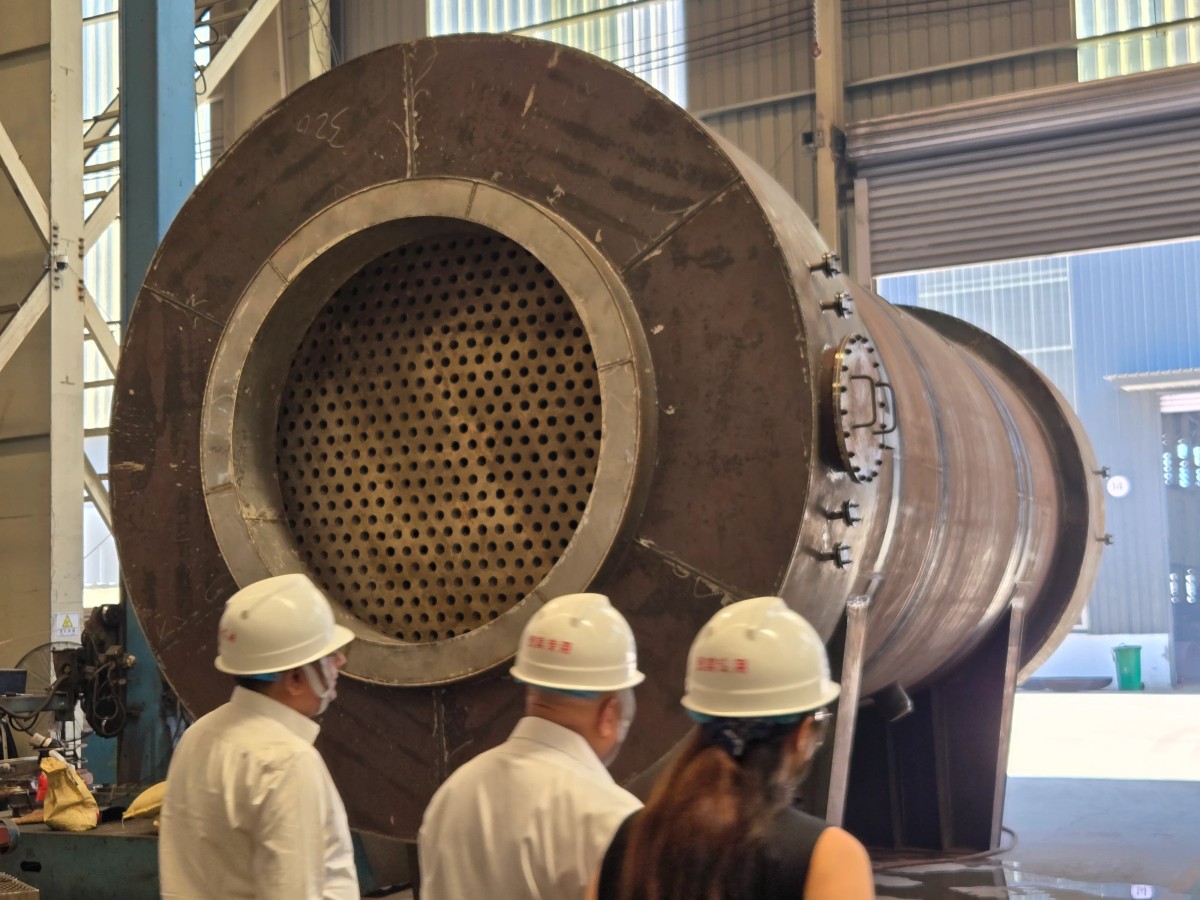
Coke dry quenching is the highest-grade heat recovery point in an integrated steel plant, and its waste heat boiler is usually the most demanding piece of pressure equipment on site. It is also the one with the longest and best-documented record of tube failures — erosion, deposition, dew point corrosion and thermal fatigue have all been chased in CDQ service since the 1970s.
That record is worth reading carefully, because almost every failure mode traces back to a specific design decision or a specific fabrication tolerance. This article walks through the duty the boiler actually sees, the constraints that govern the design, and what has to be right in the shop.
1. What the boiler sees
The CDQ loop is closed and inert, which is what makes it attractive and what makes it difficult. Red-hot coke at around 1,000–1,200 °C is charged into the pre-storage chamber at the top of the CDQ furnace and descends into the cooling chamber, where circulating nitrogen-rich gas rises counter-current through the bed and leaves through sloping flues into an annular duct. Coke leaves the chamber at about 200 °C.
For a 56 t/h plant, the circulating gas leaves the cooling chamber at roughly 800–850 °C, passes through the primary dust catcher, and enters the boiler; it leaves the boiler at about 180 °C, then passes the secondary dust catcher to the circulation blower, where pressure is boosted and composition corrected with nitrogen before re-injection at the bottom of the chamber. Where a sub-economizer is fitted, gas temperature drops to around 130 °C, which improves cooling chamber efficiency.
Modern single-chamber units run considerably larger — capacities span roughly 56 t/h to 280 t/h. Steam parameters vary with the intended use: a widely quoted design level is 3.82 MPa and 450 °C, yielding about 0.54 t of steam per tonne of dry-quenched coke, while early Kawasaki units were much more modest — forced circulation water tube boilers of 38 t/h at 13 kg/cm²G with 270 °C superheater outlet. Overall recovery sits in the range of 0.3–0.6 MWh per tonne of coke, or, expressed the way plant energy managers usually do, 500–700 kgce of steam and 140–185 kWh of power per tonne of coke depending on operating mode and steam conditions.
Two details of the loop matter more than their footnote status suggests. First, air is deliberately admitted to the circulating gas to burn combustibles and coke dust, raising gas temperature and increasing steam output — so the boiler inlet condition is partly an operating lever, not a fixed number. Second, an annual operating ratio of about 95 % is achievable, but the cited route to it is a combination of double flue technology, appropriate refractories and highly reliable equipment. Availability is engineered in; it is not a property of the process.
2. Coke dust erosion: the dominant failure mode
Flue gas carrying large quantities of coke powder wears the heating surface tubes badly as it enters the boiler, and this abrasive wear is the classic CDQ failure mode.
The most useful single finding on this comes from early Soviet work at the Cherepovets works, where the boiler weaknesses were identified as intense erosion of heating surfaces and blockage of coils by deposits: 85–90 % of the wear was caused by particles larger than 100 μm, and removing that fraction from the gas stream reduced tube wear by a factor of six to nine.
The engineering consequence is blunt. Primary dust catcher performance is a boiler design parameter, not a separate scope item. A boiler quoted against an optimistic inlet dust specification will be under-designed by close to an order of magnitude in wear terms, and the gap will not show up until the second or third year.
Beyond dedusting, the standard countermeasures fall into three groups: controlling gas velocity through structural improvements, reinforcing the wear-prone sections — anti-wear tiles and shields on the exposed rows — and applying wear-resistant coatings by thermal spraying. Gas velocity and heating surface material are the two factors with the largest influence. In practice this means a boiler that looks oversized against a clean-gas thermal calculation: wider pitch, lower velocity, more surface.
3. Deposition, local overheating and thermal fatigue
Coke dust in the circulating gas also forms loose deposits on heating surfaces, and the chain of consequences is reduced heat transfer, local tube overheating and thermal stressing. Documented damage causes for dry quenching boiler heating surfaces include tube overloading and thermal ageing, fluctuating thermal loads, internal and external corrosion, erosion and abrasive wear, and failure to maintain correct water conditions.
Note what is on that list. Two of the five causes are not metallurgical at all — fluctuating thermal load and water chemistry. CDQ is charged batch-wise, steam output tracks coke input almost proportionally, and every deviation in charging rhythm is a thermal transient in the tube bank. A boiler sized and stress-checked for one steady duty point will accumulate fatigue nobody budgeted for.
Related, and frequently underestimated: uneven gas distribution across the inlet tubes at the hot end is a recurring contributor to waste heat boiler problems generally. In CDQ, where the gas arrives from an annular duct via a dust catcher, inlet duct geometry and flow straightening deserve CFD attention rather than a standard transition piece.
4. The cold end: acid dew point versus efficiency
There is a direct conflict at the cold end of a CDQ boiler. Dropping the circulating gas temperature further — the sub-economizer taking it to around 130 °C — improves cooling chamber efficiency. It also walks the cold-end metal temperature toward the sulphuric acid dew point.
The failure consequence is documented: sulphuric acid dew point corrosion in the boiler has caused tube bursts in CDQ service, while high dust content causes blockage, and together these produce short service life and reduced safety. This is precisely the combination that made some early adopters keep wet quenching as a backup.
Two levers control it:
Metal temperature. Feedwater temperature and economizer arrangement must keep the tube wall above the acid dew point across the operating range, not only at the design point. This is where the sub-economizer decision should be made — explicitly, with a number, not inherited from a reference plant with different sulphur input.
Material. 09CrCuSb, generally known as ND steel, is the standard selection for sulphuric acid low-temperature dew point resistance and is widely used for economizers, air preheaters and heat exchangers in high-sulphur flue gas service, specifically characterised for sulphur-bearing gas below about 200 °C. Acceptance is by a 24-hour immersion in 50 % H₂SO₄ at 70 °C against a specified maximum average corrosion rate. Two cautions: the composition was substantially revised in NB/T 47019-2021 with higher Cu, Sb, Sn, Mo and W, so the edition matters; and ND steel is not unconditional — in a blast furnace gas line it leaked after three years against a nine-year design life once wet dedusting dropped the metal below the dew point and produced a bottom-of-pipe condensate near pH 2 with high chloride.
Where carbon steel is acceptable in the low-temperature zone, finned tubes have long been used for the evaporator and economizer to recover the surface area lost to the lower gas temperature — a sound approach provided fin pitch is chosen against the real dust loading rather than a clean-gas correlation.
5. Gas tightness is a safety function
The circulating gas contains carbon monoxide and hydrogen, and the loop operates at controlled composition with nitrogen make-up. Air ingress does two unwelcome things at once: it shifts the combustible content toward an explosive range, and it consumes coke. This is why extremely tight wall construction is listed alongside anti-abrasion and dust deposition control as a core CDQ boiler design consideration.
For the fabricator, this converts an efficiency item into a hold point. Membrane panel weld integrity, casing seal detailing, penetration design for soot blowers, instruments and supports, and a documented tightness test on the assembled gas-side enclosure are all safety-critical rather than cosmetic.
6. The reliability record, read honestly
CDQ boilers earned a reputation for unreliability, and it was not undeserved — the Cherepovets erosion work dates from the late 1970s, Kawasaki's tight-wall and anti-abrasion design measures from the same period, and Baosteel published a tube-cracking analysis of its own CDQ boiler in 2000.
The useful reading of that history is that the failure modes are known, bounded, and addressable. They cluster around four things: inlet dust specification, gas velocity and distribution, cold-end metal temperature, and manufacturing consistency of the heating surface. Where all four are handled, 95 % annual availability is a realistic target. Where any one is handled by assumption rather than by calculation, the boiler will find it.
7. What fabrication decides
Design intent survives only if the pressure parts are built to the drawing. In CDQ service this is not a formality, because several of the design countermeasures are themselves fabrication items.
Serpentine coils. Wall thinning and ovality at bends, consistency of bend radius across hundreds of nominally identical coils, and accurate finished pitch. Pitch drift changes local gas velocity — which is the parameter the anti-erosion design was built on. Dimensional scatter quietly converts a protected design into an exposed one.
Anti-wear provisions. Shields, tiles and thermally sprayed coatings only work if they are fitted where the flow actually accelerates, are attached in a way that survives thermal cycling, and do not themselves create a step that starts a new erosion pattern. Attachment detailing is shop work, and it is worth reviewing at the drawing stage.
Membrane panels and gas-tight enclosure. Full, uniform fin weld penetration with controlled distortion; panel flatness sufficient for the erection crew to actually seal the casing; tightness testing as a hold point.
Welding. Qualified WPS/PQR for every material and thickness combination, welder qualification matched to the real joint configuration, controlled preheat and interpass temperature, PWHT where the code requires it. Dissimilar joints — carbon steel to ND steel at the cold-end transition — need their own procedure rather than a generic qualification.
Examination. Radiography, increasingly digital so the feedback loop to the welder is measured in hours rather than days; ultrasonic or phased array where geometry allows; hydrostatic test; gas-side tightness test. For dew-point-service material, the mill certificate should carry the corrosion test result, not just chemistry.
Water side. Since incorrect water conditions sit on the documented damage list, internal cleanliness at handover matters: pickling and passivation scope, preservation during transport and storage, and a clean commissioning procedure.
Trial assembly. CDQ retrofits run on short outage windows. Shop trial assembly of headers, coil banks and casing sections, match-marked with documented shipping splits, converts site risk into shop hours.
8. Buyer's checklist
- What inlet dust loading and particle size distribution is the boiler designed for, and does it match the primary dust catcher's guaranteed performance — particularly the fraction above 100 μm?
- What gas velocity has been selected in each pass, and what anti-wear provisions are fitted where?
- What is the guaranteed minimum cold-end metal temperature, at minimum load, and what material is used there? Is ND steel specified to the current NB/T 47019 edition?
- Is a sub-economizer included, and has its effect on cold-end corrosion been quantified rather than assumed?
- Has cyclic duty been addressed in the stress analysis, and how is steam output buffered against charging rhythm?
- Gas-side tightness: what test, at what stage, to what acceptance criterion?
- Which code and third-party inspector, and what NDE extent — as percentages?
- Which operations are in-house at the fabricator (coil bending, panel welding, radiography) and which are subcontracted?
9. Closing
A CDQ waste heat boiler is not a difficult machine thermodynamically. It is a difficult machine mechanically, and the difficulty is concentrated in the heating surface: hundreds of coils that have to be geometrically identical, welded to a standard that survives cyclic duty, protected exactly where the coke dust actually strikes, and made of the right material at the cold end.
Boyu manufactures precisely this scope — serpentine coils, membrane panels and headers for boiler pressure parts — as a designated coil production base for Harbin Boiler Works and Shanghai Boiler Works, and as a supplier to Dongfang Boiler Group. The shop holds ASME S and U stamps together with Class A boiler and A2/A3 pressure vessel licences, and operates its own digital radiography for weld examination. If you are specifying or re-tubing a CDQ boiler, we are glad to review the heating surface scope with your design institute or EPC contractor.
PROFESSIONAL CONSULTATION
If you are interested in our products and want to know more details, please leave a message here, we will reply you as soon as we can.