

A waste heat boiler recovers thermal energy from a hot gas stream that would otherwise be vented to atmosphere, and converts it into steam or hot water. The gas source can be a gas turbine exhaust, a cement kiln, a sulphuric acid converter, a coke oven, a reformer furnace, an incinerator, or a metallurgical off-gas duct. Wherever a process discharges flue gas at an elevated temperature, there may be an opportunity for economic heat recovery. Feasibility depends on gas temperature and flow rate, annual operating hours, fouling and corrosion conditions, and the required steam or hot-water duty.
Most technical articles classify waste heat boilers by circulation method or by heat source. That is useful for a design engineer, but it is not the question a buyer actually faces. In practice, the first decision is a scope decision.
A Complete Waste Heat Boiler Unit
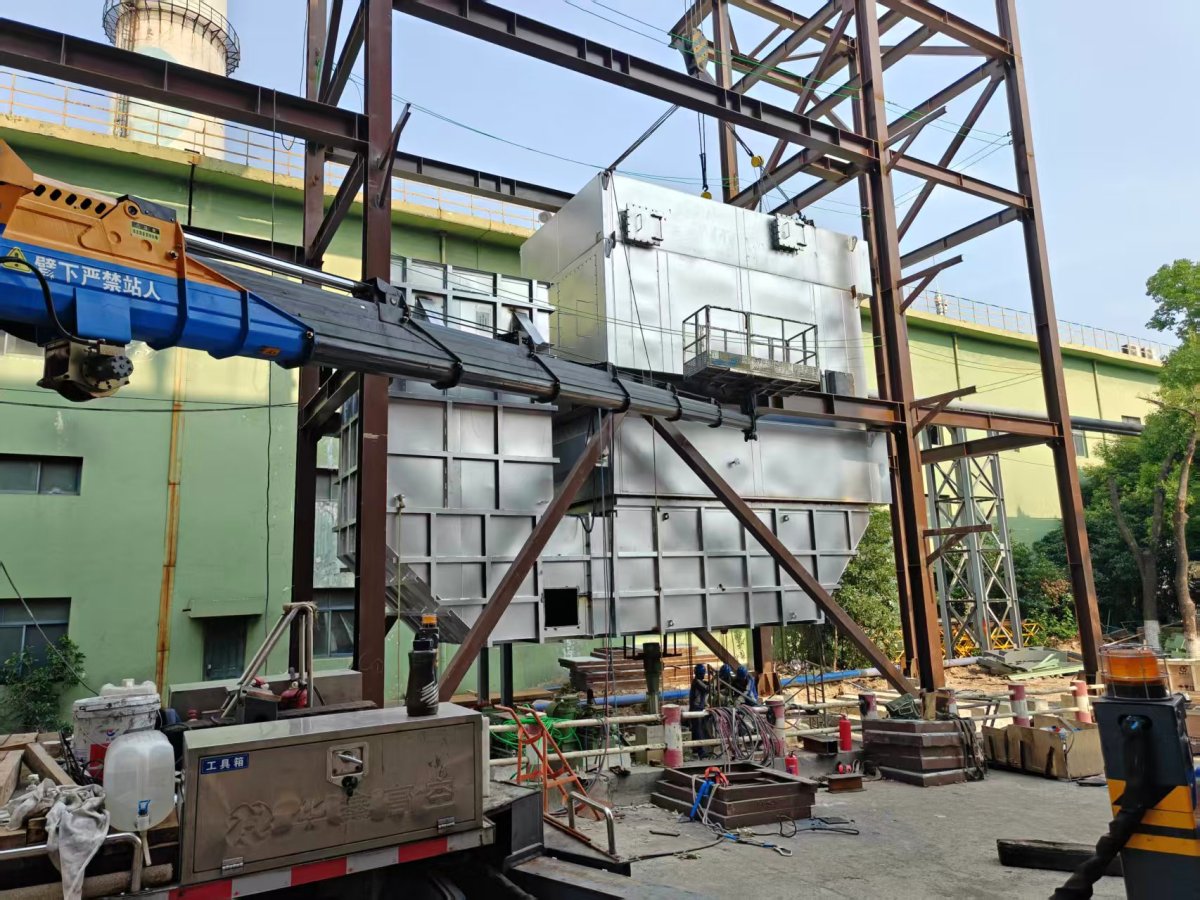
A complete engineered boiler system including the applicable steam-water circulation system, pressure parts, casing, supports, valves and instruments, delivered as an integrated working unit.
Heating Surface Modules
Serpentine tube coils, finned tube panels and header assemblies, manufactured to a boiler OEM's or EPC's drawings and integrated into their design.
These are two different products, two different supply chains and two different sets of manufacturing risks. This article explains both, and how to tell which one your project needs.
Part 1: The Complete Waste Heat Boiler Unit
What Is Inside It
A conventional drum-type waste heat boiler is built around a steam drum. The drum is the point where the steam–water mixture separates: saturated steam leaves the top, and water returns through downcomers to the evaporator inlet headers. Around that core sit the pressure parts arranged in the direction of gas flow:
- Superheater — typically located in the higher-temperature gas region, raising saturated steam to the required outlet temperature.
- Evaporator — the boiling section, connected to the drum by risers and downcomers.
- Economizer — at the cold end, preheating feedwater and pulling the stack temperature down to the design minimum.
Inside the drum, cyclone separators, chevron dryers and mesh pads control moisture carryover. Continuous and intermittent blowdown connections, chemical dosing lines, level instrumentation and safety valves complete the system.
Natural Circulation vs. Forced Circulation
In a natural circulation boiler, flow through the evaporator is driven by the density difference between the cooler water in the downcomers and the steam–water mixture in the risers. It needs no pump, has no rotating equipment in the circulation loop, and is inherently reliable — but it requires vertical height to generate the driving head, and it constrains how the tube bundles can be arranged.
In a forced circulation boiler, a circulation pump moves water through the evaporator. This frees the designer to use horizontal tube banks and lower overall height, which matters when the boiler has to fit an existing plant layout or a tight transport envelope. The trade-off is a rotating machine in the critical loop, usually with an installed spare.
Why the Drum Matters
The drum is not just a separator; it is a buffer. Its water inventory absorbs load swings, gives the control system time to react, and provides a safety margin during upsets. It is also where water chemistry is managed — blowdown and dosing at the drum are what keep dissolved solids under control and protect the tubes from scaling and caustic attack.
That combination is why drum-type units are widely used in applications with continuous operation, stable steam demand and strict steam purity requirements: sulphuric acid plants, cement kiln AQC and PH boilers, coke dry quenching, ammonia and methanol reformer waste heat sections, hazardous waste incineration lines, and packaged HRSGs behind smaller gas turbines and engines.
What You Give Up
Complete units are tall, heavy and capital-intensive. Their large water inventory means slower cold starts. Foundations, structural steel and erection scope are all significantly larger. For a small or intermittent heat source, the payback can be difficult to justify.
Part 2: Heating Surface Modules — Serpentine Tube Coils
What They Are
A heating surface module is a pressure-part assembly, not a boiler. Typically it consists of serpentine (coil) tube elements welded into inlet and outlet headers, spaced and supported by straps and tube support plates, and shipped as a lift-and-set module that the customer installs inside their own gas duct or casing.
The tubes may be bare, or extended with fins to increase surface area on the gas side:
- Spiral finned tube — high surface ratio, used with clean gas such as gas turbine exhaust.
- H-type and double-H finned tubes — their open gas-flow passages and fin arrangement provide better fouling tolerance and facilitate soot blowing in dusty flue-gas service.
- Bare serpentine tube — used at the hot end, in high-dust service, and wherever fin root corrosion is a risk.
Who Buys Modules Rather Than Boilers
Three groups, mainly:
- Boiler OEMs and HRSG designers who own the thermal design and outsource pressure-part fabrication. They supply the drawings; the module maker supplies capacity, welding qualification and code compliance.
- EPC contractors building a plant where the boiler casing and steel are fabricated locally and only the pressure parts are imported.
- Operating plants replacing worn or corroded sections — superheater re-tubes, economizer bundle replacements, and coil sections damaged by ash erosion. This is a large and steady market, and it is usually urgent, because the plant is down while it waits.
Where the Manufacturing Difficulty Actually Sits
A serpentine coil looks simple. It is not. The controlling issues are:
- Bending quality. Tight bend radii — R/D ratios approaching 2 — concentrate strain on the extrados. Wall thinning and ovality at the bend must stay inside code and specification limits, which drives mandrel selection, bending speed and, for alloy steels, post-bend heat treatment.
- Dimensional consistency across hundreds of elements. A single bundle can contain hundreds of coils that must all nest into the same header pitch and the same casing envelope. Fixturing and jigging discipline is what separates a good coil shop from an average one.
- Header work. Stub hole drilling, tube-to-header welds, and the NDE that follows are where most non-conformances appear.
- Fin welding. High-frequency welded fins must be metallurgically bonded, not just attached; a poor bond becomes a hot spot and later a failure.
- Modularization for transport. Module split lines have to respect road and container limits without creating field welds in awkward positions.
What You Give Up
Buying modules usually means the customer, boiler OEM, EPC contractor or licensor retains the thermal-design and system-integration responsibility. Under a fabrication-only scope, the module supplier is typically responsible for materials, dimensions, welding, inspection and code compliance in accordance with the approved drawings and specifications, while overall boiler performance remains with the thermal designer unless otherwise agreed.
Side-by-Side Comparison
How to Decide
If your team or your licensor has already produced a heat balance, tube layout and general arrangement, you need a fabricator — buy modules and keep the design in-house. If you have a gas stream, a steam demand and no boiler design, you need a boiler supplier — buy a complete unit and transfer the performance risk.
The intermediate case is a retrofit into an existing plant. Here the gas duct geometry, the available height and the tie-in points are all fixed, and the practical answer is usually modules engineered to fit the existing envelope, with the circulation system reused.
Codes, Materials and Quality
Waste heat boiler pressure parts are code equipment. Depending on the equipment classification, destination market and project requirements, applicable construction rules may include ASME BPVC Section I for power boilers, ASME BPVC Section VIII Division 1 for pressure vessels within its scope, PED/EN 12952, or applicable Chinese GB/T 16507 series standards and TSG 11-2020 requirements. Common materials include SA-192, SA-210 A1 and SA-106 B for lower-temperature sections; SA-213 T11, T12 and T22 for superheaters; and stainless or nickel alloys where the gas is corrosive.
Whichever route you take, the questions worth asking a supplier are the same: which code stamps do they hold, are their WPS/PQR qualified for the actual material and thickness combinations, what is their in-house bending capacity, and can they show serial production of the specific coil geometry you need — not just a certificate on a wall.
About Shandong Boyu Heavy Industry
Boyu manufactures both categories described above. We build complete waste heat boilers and pressure vessels, and we operate a large-scale serpentine tube production base in China, supplying heating surface modules to boiler OEMs and EPC contractors worldwide — including HRSG heating surfaces delivered to Shanghai Boiler Works for GE 9F and 9H class gas turbine projects.
Our qualifications include ASME S and ASME U stamps, a Class A boiler manufacturing licence, A2 and A3 pressure vessel licences, and ISO 9001, ISO 14001 and ISO 45001 certification.
Complete Boiler or Heating Surface Modules?
Send us your gas conditions and steam requirement, or your coil drawings, and we will tell you which route fits your project — including when the answer is that you do not need us.
Send Your Project DataFrequently Asked Questions
What temperature does a waste heat source need to be worth recovering?
As a rough guide, steam generation becomes attractive above about 300 °C, and hot water or thermal oil recovery can still pay back between roughly 150 °C and 300 °C. The real determinant is not temperature alone but gas mass flow, annual operating hours and local fuel price.
Can a waste heat boiler work without a steam drum?
Yes. Once-through and coil-type designs have no drum; feedwater enters one end of the coil and steam leaves the other. They start quickly and occupy little space, but they demand tight feedwater quality control and precise flow distribution, and they are less tolerant of load swings.
What is the difference between a waste heat boiler and an HRSG?
An HRSG (heat recovery steam generator) is a waste heat boiler specifically designed for gas turbine exhaust. The term "waste heat boiler" is broader and covers process gas, kiln gas, incinerator gas and metallurgical off-gas as well.
How long does a heating surface module take to manufacture?
For a repeat coil geometry in carbon steel with materials in stock, production is typically completed within several weeks after drawing approval, subject to material availability and fabrication complexity. For alloy superheater sections requiring imported tube, mill delivery may control the schedule rather than fabrication itself.
Can existing coils be replaced without changing the boiler casing?
Often, yes — subject to verification of the existing casing envelope, header centrelines, support points and field tie-in conditions. Replacement modules can then be engineered to fit the existing envelope so that the outage scope remains focused on removal, lift-in and field connections.