

Our News
Find out about our latest news here.
Latest News
- ▶ Buying Pressure Vessels from China: How to Read a Q345R and an SA-516 Gr.70 Mill Certificate
- ▶ Boyu Heavy Industry Adds Power Engineering Construction License to Its ASME-Certified Manufacturing Base
- ▶ Inside the Shop: What Those Chalk Marks on a Vessel Mean
- ▶ Gas Turbine HRSG Heating Surfaces: Design, Materials, Finned Tubes and Manufacturing
- ▶ Waste Heat Boilers Explained: Complete Units vs. Heating Surface Modules
- ▶ Sourcing Large Pressure Vessels from China: What Buyers Should Verify Before Awarding
Message
Somewhere in most China-sourced pressure vessel packages there is a line that reads "Q345R (equivalent to SA-516 Gr.70)". It appears on drawings, on quotations, and occasionally on the material certificate itself.
It is a convenient phrase. It is also not a statement that any construction code recognises.
Below are two real mill certificates — one Q345R, one SA-516 Gr.70N — for plate of almost the same thickness, from two of the larger Chinese mills. Read side by side, they show exactly where the two grades separate and which fields actually decide whether the material is acceptable on your project.
(Both documents are reproduced as redacted specimens. Commercial identifiers have been removed and the pages are watermarked; they are illustrations, not usable certificates.)
Certificate 1 — Q345R
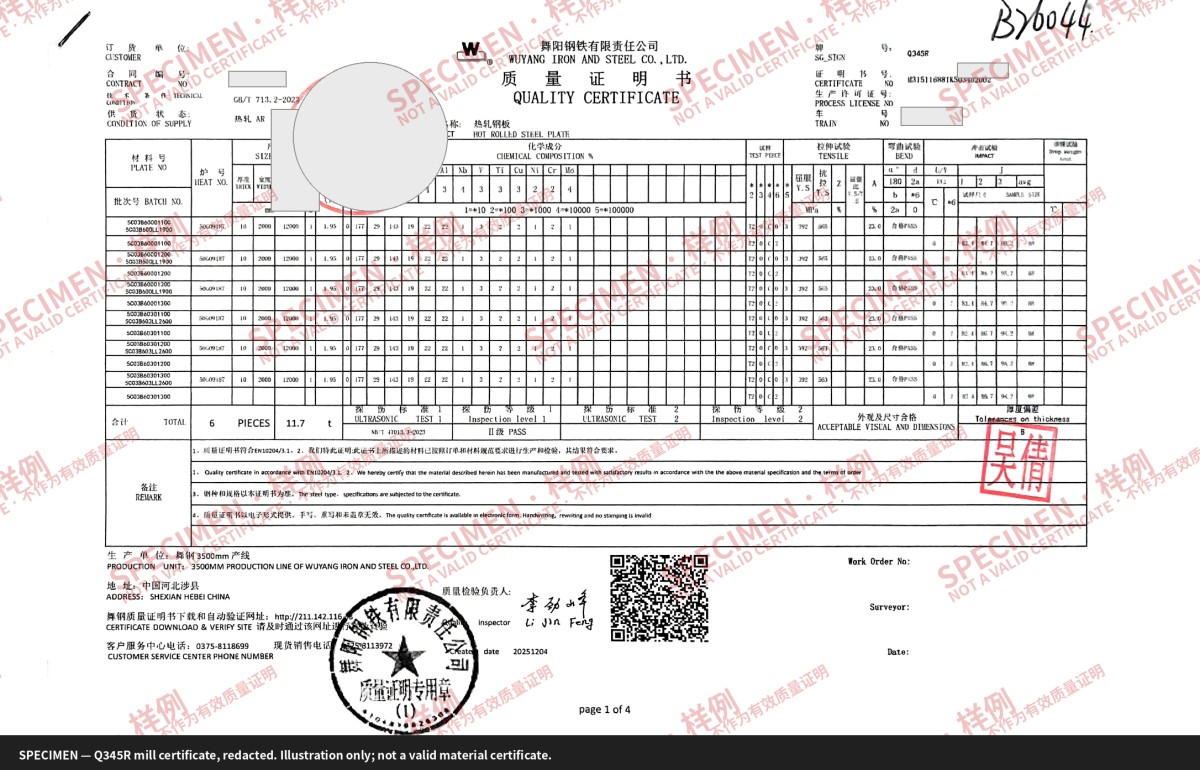
What the document says
Certificate 2 — SA-516 Gr.70N
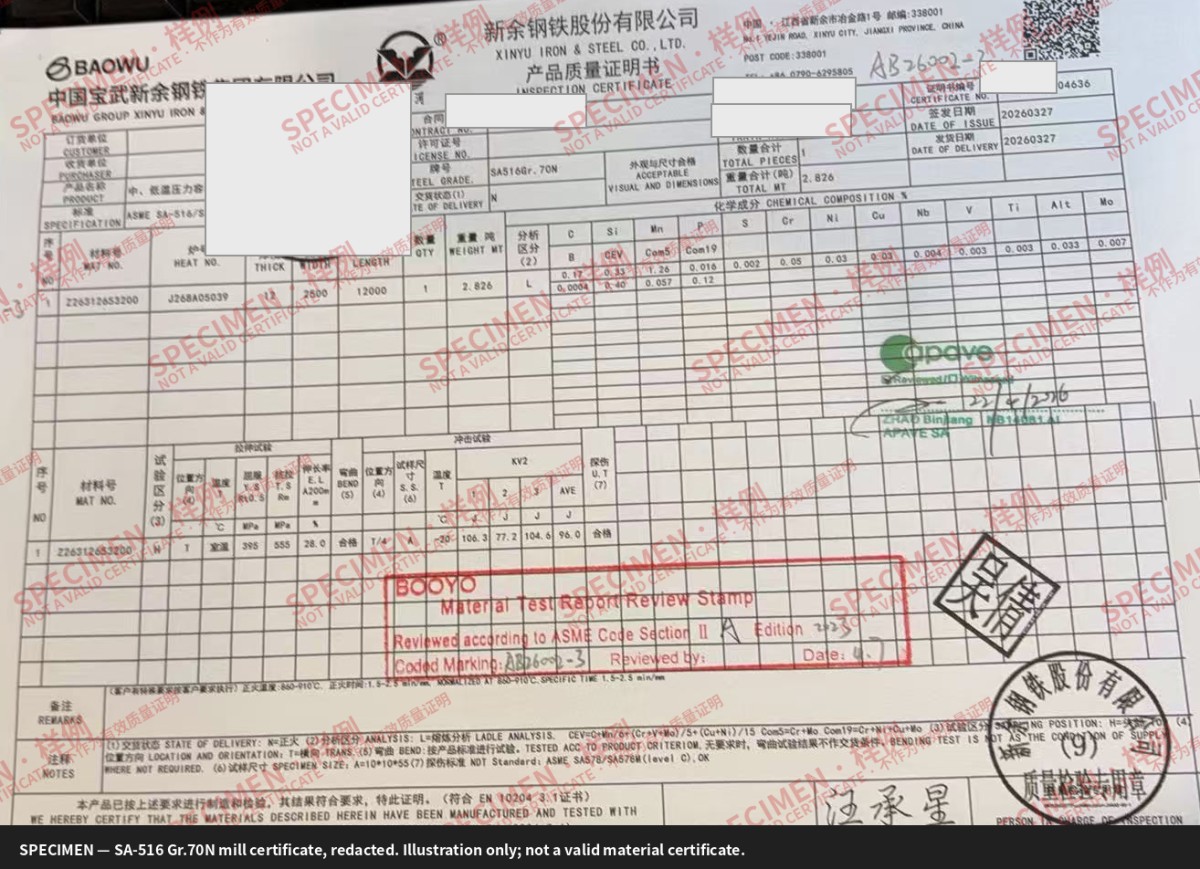
What the document says
Six things the two documents show
1. The measured properties really are close — and that is the trap
Yield strength, as tested: 392 MPa on the Q345R plate, 395 MPa on the SA-516 Gr.70N plate. Three megapascals apart.
Anyone comparing those two numbers would reasonably conclude the grades are interchangeable. That conclusion is wrong, because design does not use the tested value. It uses the specified minimum.
The SA-516 plate is carrying 135 MPa of margin above its specified minimum. The Q345R plate is carrying 47 MPa. Two plates that test almost identically are permitted to be very different plates, because the specifications allow different worst cases — and the designer is obliged to assume the worst case.
This single misunderstanding is the source of most "but they're equivalent" arguments.
2. The specification field decides acceptability, not the properties
One certificate names GB/T 713.2-2023. The other names ASME SA-516/SA-516M.
ASME VIII-1 requires material listed in ASME Section II. A plate certified only to a GB standard is not acceptable in a U-stamped vessel no matter how its test results read. Conversely, SA-516 Gr.70 can be used in a GB 150 vessel subject to the purchaser's agreement and the applicable acceptance route.
If you read one field on a Chinese mill certificate, read this one.
3. Delivery condition differs, and it follows the plate into design
The Q345R plate is supplied as-rolled. The SA-516 plate is suppliednormalized.
This is not a detail. Delivery condition affects toughness, and under ASME VIII-1 it changes which UCS-66 curve the material sits on — which in turn changes the minimum design metal temperature the vessel can be stamped for. A vessel designed on the assumption of normalized plate cannot be built from as-rolled plate without re-evaluation.
Check that the condition on the certificate matches the condition the design calculation assumed.
4. Impact testing is ordered, not inherited
The Q345R certificate shows impact at 0 °C — that is the base specification's own requirement; it comes with the grade.
The SA-516 certificate shows impact at −20 °C — that is not standard. SA-516 carries no mandatory impact requirement. Testing at −20 °C means somebody specified a supplementary requirement at the time the plate was ordered.
So: if your vessel has a low MDMT and the specification says SA-516 Gr.70 with nothing further, you have not ordered impact testing. It has to be called out on the purchase order. It cannot be added after rolling.
5. The NDE standards are different documents
Ultrasonic examination on the Q345R plate is to NB/T 47013.3-2023 at inspection level I, accepted at grade II. On the SA-516 plate it is to ASME SA578/SA578M level C.
Both are legitimate. They are not the same acceptance criteria, and a specification that simply says "UT required" has not said which one applies. State the standard and the acceptance level on the enquiry
PROFESSIONAL CONSULTATION
If you are interested in our products and want to know more details, please leave a message here, we will reply you as soon as we can.