

Our News
Find out about our latest news here.
Latest News
- ▶ Straw-Fired Biomass Boilers from a Manufacturer in China
- ▶ BOYU Adds a New High Frequency Welded Serrated Fin Tube Production Line
- ▶ Why Radiography Often Fails on Spiral Plate Heat Exchanger Shells — and How Phased Array UT Solves It
- ▶ EAC Certification for Chinese Pressure Vessels: What It Takes to Export Under TR CU 032/2013
- ▶ Spiral Plate vs Shell and Tube Heat Exchanger: Which One Fits Your Duty?
- ▶ CDQ Waste Heat Boilers: What Governs the Design, and What Actually Breaks
Message
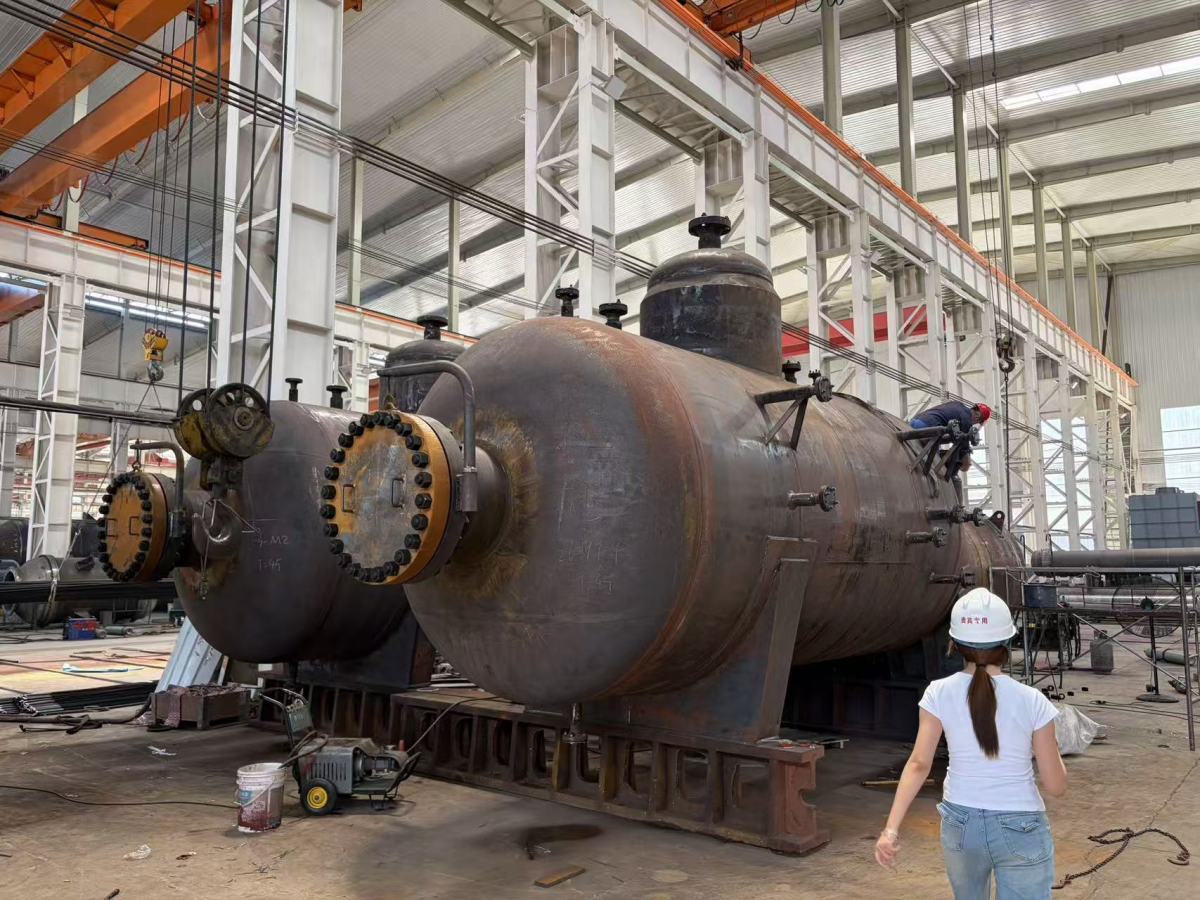
Walk into any pressure vessel shop and you'll find the same thing: multi-ton carbon steel shells covered in handwriting. Chalk, paint stick, sometimes a welder's soapstone. It looks like graffiti. It isn't.
Before a vessel has a nameplate, it has chalk. Here's the vocabulary.
T=45Plate thickness in millimetres. Chalked on the head or shell course so nobody has to walk back to the drawing table to check. On a vessel where three different courses run three different thicknesses, this is the fastest quality control there is — a fitter can spot a wrong course from twenty metres away.
M2, 3-M2, N4Nozzle and manway tags, straight off the nozzle schedule. The letter is the type, the number is the item. These go on before anyone cuts a hole, because the most expensive mistake in this building is a correctly-cut opening in the wrong place.
A long line with 0° at one endThe datum. Every nozzle orientation, every saddle, every lifting lug on the vessel is dimensioned from that one line. It's the least dramatic mark on the shell and the one you least want somebody to rub out.
A heat numberMaterial traceability. When a plate is cut, the heat number has to be transferred to every piece before the torch touches it — that's a code requirement, not a shop habit. Lose the transfer and the plate is, on paper, no longer the plate the mill certified. Somewhere in a filing cabinet there's an MTR waiting to be matched to it.
A circle, sometimes with an arrowAn NDE indication. Something showed up on the film or the UT screen at that spot. Circles are the marks people argue about, and the ones that turn into repair procedures.
Two footnotes for the specialists. On stainless steel you don't grab whatever marker is lying around — it has to be low-halide, chloride-free, or you've just planted the seed for stress corrosion cracking in a vessel that hasn't left the shop yet. And ordinary chalk absorbs moisture, which is why marks near a weld prep get wiped before the arc strikes.
Here's the part worth knowing: none of it survives. Before blasting and painting, the whole shell gets washed down and every mark disappears. Six months later that vessel is on a plinth in a refinery somewhere, grey and anonymous, and the only trace of all that handwriting is a stack of paper — the ITP sign-offs, the MTRs, the NDE reports, the U-1A.
The chalk is the draft. The data book is the final copy.
PROFESSIONAL CONSULTATION
If you are interested in our products and want to know more details, please leave a message here, we will reply you as soon as we can.